
|
You entered: massive stars
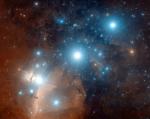 Alnitak, Alnilam, Mintaka
28.12.2006
Alnitak, Alnilam, and Mintaka, are the bright bluish stars from east to west (left to right) along the diagonal in this gorgeous cosmic vista. Otherwise known as the Belt of Orion, these three blue supergiant stars are hotter and much more massive than the Sun.
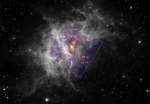 Young Star Cluster Westerlund 2
30.01.2008
Dusty stellar nursery RCW 49 surrounds young star cluster Westerlund 2 in this remarkable composite skyscape from beyond the visible spectrum of light. Infrared data from the Spitzer Space Telescope is shown in black...
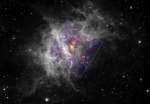 Young Star Cluster Westerlund 2
26.06.2010
Dusty stellar nursery RCW 49 surrounds young star cluster Westerlund 2 in this remarkable composite skyscape from beyond the visible spectrum of light. Infrared data from the Spitzer Space Telescope is shown in black...
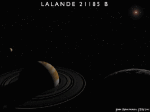 Lalande 21185: The Nearest Planetary System?
19.10.1996
What's the closest extrasolar planetary system? It may well be planets of the dim red dwarf star cataloged as Lalande 21185 -- a mere 8 light years distant. This star is too faint to be seen by the naked eye and its planets have not been imaged directly.
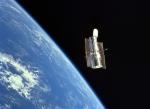 The Orbiting Hubble Space Telescope
6.08.2001
The Hubble Space Telescope (HST) is the largest orbiting public optical telescope in history. Its 2.4 meter diameter reflecting mirror and its perch above Earth's atmosphere allow it to create exceptionally sharp images.
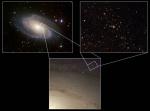 Supernova Survivor
10.09.2005
Beginning with a full view of beautiful spiral galaxy M81, follow the insets (left, bottom, then right) to zoom in on a real survivor. Seen at the center of the final field on the right is a star identified as the survivor of a cosmic cataclysm -- the supernova explosion of its companion star.
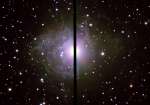 Echoes from RS Pup
11.02.2008
This dusty reflection nebula surrounds pulsating star RS Pup, some 10 times more massive than the Sun and on average 15,000 times more luminous. In fact, RS Pup is a Cepheid type variable...
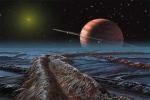 Other Worlds and HD 38529
10.08.2000
After the latest round of discovery announcements, the list of known worlds of distant suns has grown to 50. While extrasolar planet discoveries are sure to continue, none - so far - points clearly to another planetary system like our own. Take, for example, the newly discovered parent star HD38529.
 X-Rays From The Galactic Center
19.01.2000
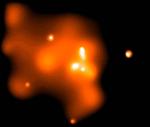
Exploring quasars and active galaxies in the distant universe, astronomers have come to believe that most galaxies have massive black holes at their centers. Swirling stars and a strong, variable radio source offer convincing evidence that even our own Milky Way galaxy's center harbors such a bizarre object, a mere 30,000 light-years away.
 Companion of a Young, Sun-like Star Confirmed
4.07.2010
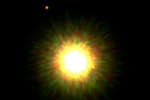
The first direct image of an extrasolar planet orbiting a star similar to our Sun has been confirmed. Located just 500 light-years away toward the constellation Scorpius, the parent star, cataloged as 1RXS J160929.1-210524, is only slightly less massive and a little cooler than the Sun.
|
January February March April |
|||||||||||||||||||||||||||||||||||||||||||||||||