
|
You entered: young stars
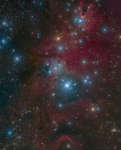 Fox Fur, a Unicorn, and a Christmas Tree
24.12.2016
Clouds of glowing hydrogen gas fill this colorful skyscape in the faint but fanciful constellation Monoceros, the Unicorn. A star forming region cataloged as NGC 2264, the complex jumble of cosmic gas and dust...
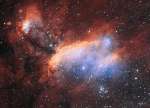 IC 4628: The Prawn Nebula
23.09.2013
South of Antares, in the tail of the nebula-rich constellation Scorpius, lies emission nebula IC 4628. Nearby hot, massive stars, millions of years young, radiate the nebula with invisible ultraviolet light, stripping electrons from atoms. The electrons eventually recombine with the atoms to produce the visible nebular glow, dominated by the red emission of hydrogen.
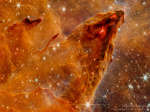 M16: A Star Forming Pillar from Webb
6.12.2022
WhatБs happening inside this interstellar mountain? Stars are forming. The mountain is actually a column of gas and dust in the picturesque Eagle Nebula (M16). A pillar like this is so low in density that you could easily fly though it -- it only appears solid because of its high dust content and great depth.
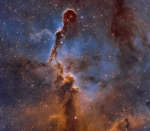 The Elephant s Trunk Nebula in Cepheus
16.08.2019
Like an illustration in a galactic Just So Story, the Elephant's Trunk Nebula winds through the emission nebula and young star cluster complex IC 1396, in the high and far off constellation of Cepheus. Also known as vdB 142, the cosmic elephant's trunk is over 20 light-years long.
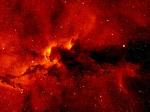 IC 1396 Close Up
30.09.2005
Clouds of glowing hydrogen gas mingle ominously with dark dust lanes in this close-up of IC 1396, an active star forming region some 2,000 light years away in the constellation Cepheus. In this and other similar emission nebulae, energetic ultraviolet light from a hot young star strips electrons from the surrounding hydrogen atoms.
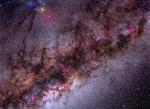 Our Galaxy in Stars, Gas, and Dust
27.09.1999
The disk of our Milky Way Galaxy is home to hot nebulae, cold dust, and billions of stars. The red nebulae visible in the above contrast-enhanced picture are primarily emission nebulae, glowing clouds of hydrogen gas heated by nearby, bright, young stars.
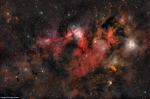 The Light, the Dark, and the Dusty
30.11.2022
This colorful skyscape spans about four full moons across nebula rich starfields along the plane of our Milky Way Galaxy in the royal northern constellation Cepheus. Near the edge of the region's massive...
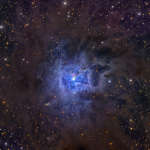 NGC 7023: The Iris Nebula
2.08.2014
These clouds of interstellar dust and gas have blossomed 1,300 light-years away in the fertile star fields of the constellation Cepheus. Sometimes called the Iris Nebula, NGC 7023 is not the only nebula in the sky to evoke the imagery of flowers, though.
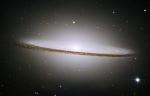 The Sombrero Galaxy from HST
15.01.2006
Why does the Sombrero Galaxy look like a hat? Reasons include the Sombrero's unusually large and extended central bulge of stars, and dark prominent dust lanes that appear in a disk that we see nearly edge-on. Billions of old stars cause the diffuse glow of the extended central bulge.
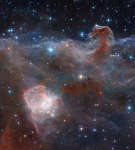 Horsehead: A Wider View
9.03.2018
Combined image data from the massive, ground-based VISTA telescope and the Hubble Space Telescope was used to create this wide perspective of the interstellar landscape surrounding the famous Horsehead Nebula. Captured at near-infrared wavelengths...
|
January February March April May June July August September October |
|||||||||||||||||||||||||||||||||||||||||||||||||