
|
You entered: distance
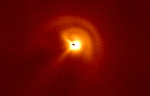 The Rotating Jets of Comet Hyakutake
14.04.1996
Comet Hyakutake will reach its closest point to the Sun on May 1, passing well inside the orbit of Mercury. At this time, the comet's dust and ion tail will be at their greatest physical length.
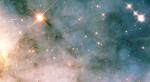 The Turbulent Neighborhood of Eta Carina
26.11.2003
How do violent stars affect their surroundings? To help find out, astronomers pointed the Hubble Space Telescope to the regions surrounding Eta Carina, a star showing signs that it may explode sometime in the next million years.
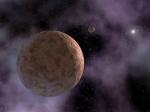 Sedna of the Outer Solar System
16.03.2004
What is the most distant known object in our Solar System? A new answer to this centuries-old question was announced yesterday by NASA with the discovery of a dark red object dubbed Sedna. Although over twice the distance to Pluto, Sedna is near its closest approach to the Sun.
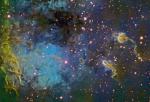 The Tadpoles of IC 410
11.01.2006
This close-up view shows a portion of otherwise faint emission nebula IC 410 in striking false-colors. It also shows two remarkable denizens of the glowing gas cloud at the right - the "tadpoles" of IC 410. The picture is a composite of images taken through narrow band filters intended to trace atoms in the nebula.
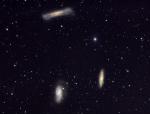 Trio Leo
9.03.2006
This popular group is famous as the Leo Triplet - a gathering of three magnificent galaxies in one field of view. Crowd pleasers when imaged with even modest telescopes, these galaxies can be introduced individually as NGC 3628 (top), M66 (bottom left), and M65 (bottom right). All three are large spiral galaxies.
 Victoria Crater on Mars
2.10.2006
Scroll right to see the largest crater yet visited by a rover on Mars. Reaching the expansive Victoria Crater has been a goal for the robotic Opportunity rover rolling across Mars for the past 21 months. Opportunity reached Victoria last week, and is cautiously probing the stadium-sized crevice.
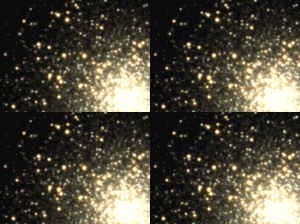 M3: Inconstant Star Cluster
15.04.2007
Star clusters appear constant because photographs of them are frozen in time. In reality, though, cluster stars swarm the center and frequently fluctuate in brightness. Although the time it takes for stars to cross...
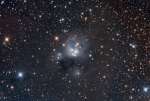 Young Suns of NGC 7129
3.10.2008
Young suns still lie within dusty NGC 7129, some 3,000 light-years away toward the royal constellation Cepheus. While these stars are at a relatively tender age, only about a million years old, it is likely that our own Sun formed in a similar stellar nursery some five billion years ago.
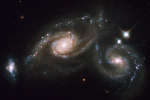 APOD: 2009 April 7 The Colliding Spiral Galaxies of Arp 274
7.04.2009
Two galaxies are squaring off in Virgo and here are the latest pictures. When two galaxies collide, the stars that compose them usually do not. This is because galaxies are mostly empty space and, however bright, stars only take up only a small fraction of that space.
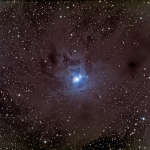 A Dusty Iris Nebula
10.06.2009
These clouds of interstellar dust and gas have blossomed 1,300 light-years away in the fertile star fields of the constellation Cepheus. Sometimes called the Iris Nebula and dutifully cataloged as NGC 7023, this is not the only nebula in the sky to evoke the imagery of flowers.
|
January February March April May June July August September October |
|||||||||||||||||||||||||||||||||||||||||||||||||