
|
You entered: Milky Way
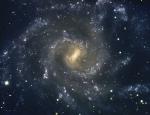 The Arms of NGC 7424
16.12.2004
The grand, winding arms are almost mesmerizing in this face-on view of NGC 7424, a spiral galaxy with a prominent central bar. About 40 million light-years distant in the headlong constellation Grus, this island universe is also about 100,000 light-years across making it remarkably similar to our own Milky Way.
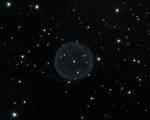 Spherical Planetary Nebula Abell 39
28.07.2005
Ghostly in appearance, Abell 39 is a remarkably simple, spherical nebula about five light-years across. Well within our own Milky Way galaxy, the cosmic sphere is roughly 7,000 light-years distant toward the constellation Hercules.
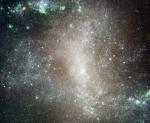 The Star Clusters of NGC 1313
26.01.2007
Like grains of sand on a cosmic beach, individual stars of barred spiral galaxy NGC 1313 are resolved in this sharp composite from the Hubble Space Telescope's Advanced Camera for Surveys (ACS). The inner region of the galaxy is pictured, spanning about 10,000 light-years.
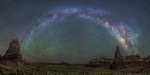 From the Temple of the Sun to the Temple of the Moon
7.10.2014
What connects the Sun to the Moon? Many answers have been given throughout history, but in the case of today's featured image, it appears to be the plane of our Milky Way Galaxy.
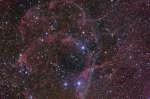 Vela Supernova Remnant
31.12.2014
The plane of our Milky Way Galaxy runs through this complex and beautiful skyscape. At the northwestern edge of the constellation Vela (the Sails) the telescopic frame is over 10 degrees wide, centered on the brightest glowing filaments of the Vela Supernova Remnant, an expanding debris cloud from the death explosion of a massive star.
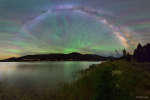 An Airglow Fan from Lake to Sky
3.02.2019
Why would the sky look like a giant fan? Airglow. The featured intermittent green glow appeared to rise from a lake through the arch of our Milky Way Galaxy, as captured during 2015 next to Bryce Canyon in Utah, USA.
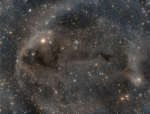 Lynds Dark Nebula 1251
3.07.2020
Stars are forming in Lynds Dark Nebula (LDN) 1251. About 1,000 light-years away and drifting above the plane of our Milky Way galaxy, the dusty molecular cloud is part of a complex of dark nebulae mapped toward the Cepheus flare region.
 APOD: 2025 July 31 Б Supernova 2025rbs in NGC 7331
31.07.2025
A long time ago in a galaxy 50 million light-years away, a star exploded. Light from that supernova was first detected by telescopes on planet Earth on July 14th though, and the extragalactic transient is now known to astronomers as supernova 2025rbs.
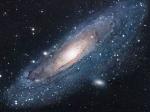 M31: The Andromeda Galaxy
26.11.2006
Andromeda is the nearest major galaxy to our own Milky Way Galaxy. Our Galaxy is thought to look much like Andromeda. Together these two galaxies dominate the Local Group of galaxies. The diffuse light from Andromeda is caused by the hundreds of billions of stars that compose it.
 A Spectacular Sky Over the Grand Tetons
14.08.2007
Behold the breathtaking beauty of Earth and sky together. In the foreground is the Teton Mountain Range of Wyoming, USA. The Grand Tetons are a relatively isolated set of high peaks that are part of the Rocky Mountains.
|
January February March April May June July August September October |
|||||||||||||||||||||||||||||||||||||||||||||||||