
|
You entered: Ring Nebula
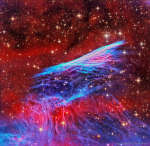 The Pencil Nebula Supernova Shock Wave
14.04.2021
This supernova shock wave plows through interstellar space at over 500,000 kilometers per hour. Near the middle and moving up in this sharply detailed color composite, thin, bright, braided filaments are actually long ripples in a cosmic sheet of glowing gas seen almost edge-on.
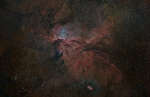 NGC 6188 and NGC 6164
1.02.2014
Fantastic shapes lurk in clouds of glowing gas in NGC 6188, about 4,000 light-years away. The emission nebula is found near the edge of a large molecular cloud unseen at visible wavelengths, in the southern constellation Ara.
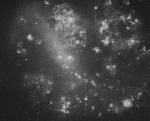 Shell Game in the LMC
18.05.2006
An alluring sight in dark southern skies, the Large Magellanic Cloud (LMC) is seen here through a narrow filter that transmits only the red light of hydrogen atoms. Ionized by energetic starlight, a hydrogen atom emits the characteristic red H-alpha light as its single electron is recaptured and transitions to lower energy states.
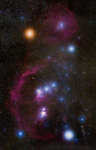 Camera Orion
21.03.2018
Do you recognize this constellation? Although it is one of the most recognizable star groupings on the sky, Orion's icons don't look quite as colorful to the eye as they do to a camera.
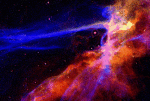 Rampaging Fronts of the Veil Nebula
7.03.1996
A supernova explosion of a high-mass star results in fast moving blast waves. At the front of the waves shown above, ionized gas in the Veil Supernova Remnant rushes out from the explosion, sweeps up material, and breaks up many atoms into constituent ions and electrons.
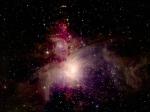 Orion Nebula: The 2MASS View
20.04.2002
Few astronomical sights excite the imagination like the nearby stellar nursery known as the Orion Nebula. The Nebula's glowing gas surrounds hot young stars at the edge of an immense interstellar molecular cloud only 1,500 light-years away.
 APOD: 2024 January 16 Б The Orion You Can Almost See
16.01.2024
Do you recognize this constellation? Although it is one of the most recognizable star groupings on the sky, this is a more full Orion than you can see -- an Orion only revealed with long exposure digital camera imaging and post- processing.
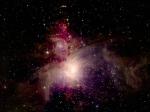 Orion Nebula: The 2MASS View
12.06.1998
Few astronomical sights excite the imagination like the nearby stellar nursery known as the Orion Nebula. The Nebula's glowing gas surrounds hot young stars at the edge of an immense interstellar molecular cloud only 1,500 light-years away.
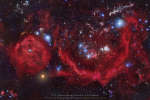 The Orion You Can Almost See
21.08.2019
Do you recognize this constellation? Although it is one of the most recognizable star groupings on the sky, this is a more full Orion than you can see -- an Orion only revealed with long exposure digital camera imaging and post-processing.
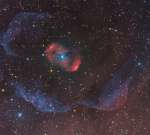 A Halo for NGC 6164
22.05.2014
Beautiful emission nebula NGC 6164 was created by a rare, hot, luminous O-type star, some 40 times as massive as the Sun. Seen at the center of the cosmic cloud, the star is a mere 3 to 4 million years old.
|
January February March April May June July August September October |
|||||||||||||||||||||||||||||||||||||||||||||||||