
|
You entered: planet
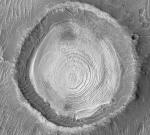 Sedimentary Mars
15.08.2003
High-resolution imaging of an area in the Schiaparelli Basin of Mars on June 3 by the MGS Mars Orbiter camera produced this stunning example of layered formations within an old impact crater. On planet...
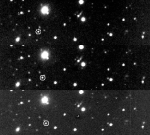 Irregular Moons Discovered Around Uranus
3.11.1997
Where did these two irregular moons of Uranus originate? Last week two previously undiscovered moons of the distant gas planet were confirmed, the first in irregular orbits. All fifteen previously known moons of Uranus are 'regular', circling near the planet's equator. Most of these were discovered by the passing Voyager 2 spacecraft in 1986.
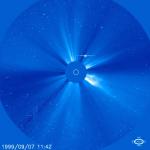 A Superior Conjunction Of Mercury
8.09.1999
In astronomical parlance, an interior planet is at superior conjunction when it is located on the opposite side of the Sun from Earth. Mercury, the solar system's innermost planet, zips past this point in its orbit today.
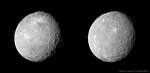 Dark Craters and Bright Spots Revealed on Asteroid Ceres
17.02.2015
What are those bright spots on asteroid Ceres? As the robotic spacecraft Dawn approaches the largest asteroid in the asteroid belt, the puzzle only deepens. Sharper new images taken last week and released yesterday...
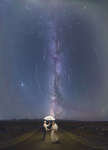 Perseid Rain
15.08.2021
Comet dust rained down on planet Earth last week, streaking through dark skies in the annual Perseid meteor shower. The featured picture is a composite of many images taken from the same location over the peak night of the Perseids.
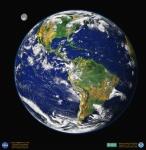 Big Blue Marble Earth
26.04.2003
This reconstructed digital portrait of our planet is reminiscent of the Apollo-era pictures of the "big blue marble" Earth from space. To create it, researchers at Goddard Space Flight Center's Laboratory for Atmospheres...
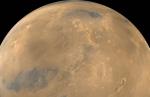 Five to Mars
2.05.2003
Come December 2003 - January 2004, an armada of five new invaders from Earth should arrive on the shores of the Red Planet -- the Japanese ( ISAS) Nozomi orbiter, the European Space Agency's Mars Express orbiter carrying the Beagle 2 lander, and NASA's own two Mars Exploration Rovers.
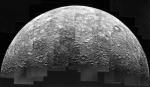 Mercury: A Cratered Inferno
12.09.2004
Mercury's surface looks similar to our Moon's. Each is heavily cratered and made of rock. Mercury's diameter is about 4800 km, while the Moon's is slightly less at about 3500 km (compared with about 12,700 km for the Earth). But Mercury is unique in many ways.
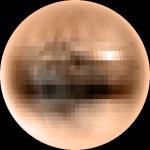 Pluto in True Color
3.09.2006
Pluto is mostly brown. The above picture captures the true colors of Pluto as well as the highest surface resolution so far recovered. Although no spacecraft has yet visited this distant world, the New Horizons spacecraft launched early this year is expected to reach Pluto in 2015.
 Martian Dust Devil Trails
21.10.2009
Who's been marking up Mars? This portion of a recent high-resolution picture from the HiRISE camera on board the Mars Reconnaissance Orbiter shows twisting dark trails criss-crossing light colored terrain on the martian surface.
|
January February March April May June July August September October |
|||||||||||||||||||||||||||||||||||||||||||||||||