
|
You entered: rings
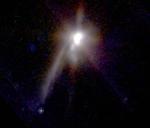 An Extrasolar Planet?
29.05.1998
This infrared Hubble Space Telescope view may contain the first ever direct image of a planet outside our own solar system. The picture shows a very young double star located about 450 light-years away toward the constellation of Taurus.
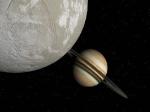 Worlds of a Distant Sun: 47 Ursae Majoris b
5.10.1997
In the last few years, observational astronomy has given humanity evidence of the existence of worlds beyond the solar system. Solar-type stars are now inferred to harbor planets of approximately Jupiter mass - some residing in temperature zones which could conceivably support liquid water and therefore life!
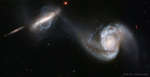 Arp 87: Merging Galaxies from Hubble
11.08.2019
This dance is to the death. Along the way, as these two large galaxies duel, a cosmic bridge of stars, gas, and dust currently stretches over 75,000 light-years and joins them. The bridge...
 A Rare Hybrid Solar Eclipse
3.11.2013
A spectacular geocentric celestial event of 2005 was a rare hybrid eclipse of the Sun - a total or an annular eclipse could be seen depending on the observer's location. For Fred Espenak, aboard...
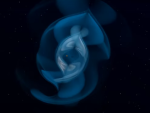 GW200115: Simulation of a Black Hole Merging with a Neutron Star
14.07.2021
What happens when a black hole destroys a neutron star? Analyses indicate that just such an event created gravitational wave event GW200115, detected in 2020 January by LIGO and Virgo observatories. To better understand the unusual event, the featured visualization was created from a computer simulation.
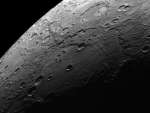 Rembrandt Impact Basin on Mercury
4.05.2009
Why do portions of this huge crater on Mercury have so much iron? The unusual Rembrandt impact basin was discovered recently in images taken during the robotic MESSENGER spacecraft's 2008 October flyby of the Solar System's innermost planet.
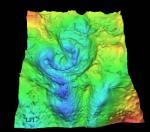 Impact: 65 Million Years Ago
26.02.2000
What killed the dinosaurs? Their sudden disappearance 65 million years ago, along with about 70 percent of all species then living on Earth, is known as the K-T event (Cretaceous-Tertiary Mass Extinction event). Geologists and paleontologists often entertain the idea that a large asteroid
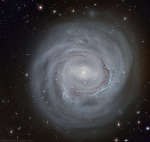 Anemic Spiral NGC 4921 from Hubble
15.05.2019
How far away is spiral galaxy NGC 4921? It's surpringly important to know. Although presently estimated to be about 300 million light years distant, a more precise determination could be coupled with its known recession speed to help humanity better calibrate the expansion rate of the entire visible universe.
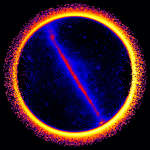 Gamma Ray Earth and Sky
6.12.2013
For an Earth-orbiting gamma-ray telescope, Earth is actually the brightest source of gamma-rays, the most energetic form of light. Gamma-rays from Earth are produced when high energy particles, cosmic rays from space, crash into the atmosphere.
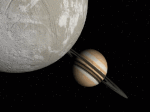 Worlds of a Distant Sun: 47 Ursae Majoris b
1.07.1996
Within the last few years, observational astronomy has given humanity evidence of the existence of worlds beyond the solar system. Indeed, solar-type stars are now inferred to harbor planets of approximately Jupiter mass - some residing in temperature zones which could conceivably support liquid water and therefore life!
|
January February March April May June July August September October |
|||||||||||||||||||||||||||||||||||||||||||||||||