
|
You entered: star cluster
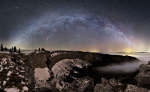 Milky Way Over Switzerland
21.02.2011
What's visible in the night sky during this time of year? To help illustrate the answer, a beautiful land, cloud, and skyscape was captured earlier this month over NeuchБtel, Switzerland. Visible in the foreground were the snow covered cliffs of the amphitheater shaped Creux du Van, as well as distant trees, and town-lit clouds.
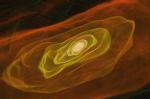 Zooming in on the First Stars
10.06.2003
What became of the first stars? No known stars appear to be composed of truly primordial gas -- all of the stars around us have too many heavy elements. Our own Sun is thought to be a third generation star, with many second-generation stars seen in globular clusters.
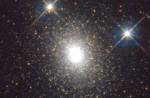 A Giant Globular Cluster in M31
26.04.1996
G1, pictured above, is the brightest known globular cluster in the whole Local Group of galaxies. Also called Mayall II, it orbits the center of the largest nearby galaxy: M31. G1 contains over 300,000 stars and is almost as old as the entire universe.
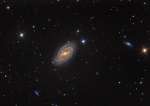 Messier 109
23.05.2013
Beautiful barred spiral galaxy M109, 109th entry in Charles Messier's famous catalog of bright Nebulae and Star Clusters, is found just below the Big Dipper's bowl in the northern constellation Ursa Major.
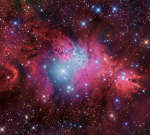 Fox Fur, Unicorn, and Christmas Tree
7.02.2019
Clouds of glowing hydrogen gas fill this colorful skyscape in the faint but fanciful constellation Monoceros, the Unicorn. A star forming region cataloged as NGC 2264, the complex jumble of cosmic gas and dust...
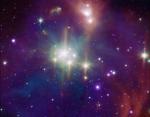 Coronet in the Southern Crown
21.09.2007
X-rays from young stars and infrared light from stars and cosmic dust are combined in this false color image of a star-forming region in Corona Australis, the Southern Crown. The small star grouping is fittingly known as the Coronet Cluster.
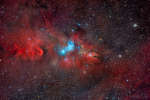 Fox Fur, Unicorn, and Christmas Tree
26.12.2020
Clouds of glowing hydrogen gas fill this colorful skyscape in the faint but fanciful constellation Monoceros, the Unicorn. A star forming region cataloged as NGC 2264, the complex jumble of cosmic gas and dust...
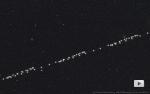 Three Years of Saturn
7.04.2007
Using an image recorded just last month as a base, this composite illustration tracks the motion of bright Saturn as it wanders through planet Earth's night sky. Starting at the upper right, Saturn's position is shown about every two weeks beginning in August 2005 and projected through September 2008.
 Unwinding M51
21.08.2020
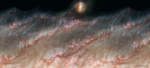
The arms of a grand design spiral galaxy 60,000 light-years across are unwound in this digital transformation of the magnificent 2005 Hubble Space Telescope portrait of M51. In fact...
 Andromeda Nebula: Var!
6.04.1996
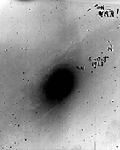
In the 1920s, using photographic plates made with the Mt. Wilson Observatory's 100 inch telescope, Edwin Hubble determined the distance to the Andromeda Nebula - decisively demonstrating the existence of other galaxies far beyond the Milky Way.
|
January February March April May June July August September October |
|||||||||||||||||||||||||||||||||||||||||||||||||