
|
You entered: Earth orbit
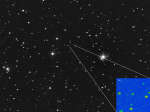 Introducing Comet ISON
1.10.2012
Could this dim spot brighten into one of the brightest comets ever? It's possible. Alternatively, the comet could break up when it gets closer to the Sun, or brighten much more modestly.
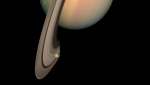 Cassini Approaches Saturn
19.04.2020
What would it look like to approach Saturn in a spaceship? One doesn't have to just imagine -- the Cassini spacecraft did just this in 2004, recording thousands of images along the way, and hundreds of thousands more since entering orbit.
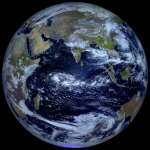 Equinox Earth
28.09.2013
From a geostationary orbit 36,000 kilometers above the equator, Russian meteorological satellite Elektro-L takes high-resolution images our fair planet every 30 minutes. But only twice a year, during an Equinox, can it capture an image like this one, showing an entire hemisphere bathed in sunlight.
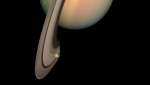 APOD: 2026 August 23 Б Cassini Approaches Saturn
23.08.2026
What would it look like to approach the grand planet Saturn? One doesn't have to just imagine -- the Cassini spacecraft did just this in 2004, recording thousands of images along the way, and hundreds of thousands more since entering orbit.
 Dione and Rhea Ring Transit
22.11.2025
Seen to the left of Saturn's banded planetary disk, small icy moons Dione and Rhea are caught passing in front of the gas giant's extensive ring system in this sharp telescopic snapshot. The remarkable image was recorded on November 20, when Saturn's rings were nearly edge-on when viewed from planet Earth.
 A Twisted Solar Eruptive Prominence
24.01.2015
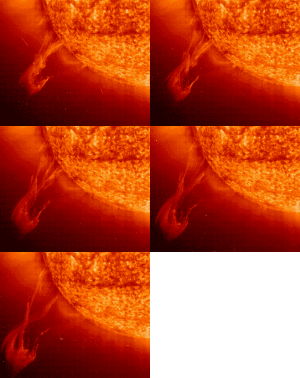
Ten Earths could easily fit in the "claw" of this seemingly solar monster. The monster, actually a huge eruptive prominence, is seen moving out from our Sun in this condensed half-hour time-lapse sequence. This large prominence, though, is significant not only for its size, but its shape.
 Vesta Vista
19.07.2011
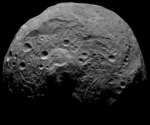
What does the surface of asteroid Vesta look like? The brightest asteroid in the Solar System and the object which takes up about 10 percent of the entire mass of the main asteroid belt had never been seen up close before.
 APOD: 2026 August 5 Б Spokes on Saturn's B Ring
5.08.2026
DonБt get spooked by SaturnБs ghostly spokes! Today we feature a nearly two-hour timelapse of Saturn and its rings looping forwards and backwards. A day on Saturn is only 10 hours long, so two hours of observation covers quite a bit of its rotation.
 The Seasons of Saturn
5.04.2003
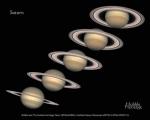
Since Saturn's axis is tilted as it orbits the Sun, Saturn has seasons, like those of planet Earth ... but Saturn's seasons last for over seven years. So what season is it on Saturn now? Orbiting the equator, the tilt of the rings of Saturn provides quite a graphic seasonal display.
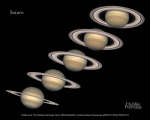 The Seasons of Saturn
21.07.2013
Since Saturn's axis is tilted as it orbits the Sun, Saturn has seasons, like those of planet Earth ... but Saturn's seasons last for over seven years. So what season is it on Saturn now? Orbiting the equator, the tilt of the rings of Saturn provides quite a graphic seasonal display.
|
January February March April May June July August September October |
|||||||||||||||||||||||||||||||||||||||||||||||||