
|
You entered: Milky Way
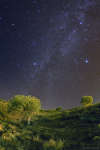 Summer Night in Astronomy Town
12.09.2009
This serene view records a late summer night sky over the rolling, green hills of planet Earth. It was taken near the rural village of Saadat Shahr, Fars province, in southern Iran. Saadat Shahr is also known as Astronomy Town, as the inhabitants have demonstrated a remarakble passion for sky gazing.
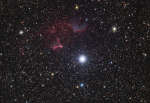 Gamma Cas and Friends
24.12.2009
Gamma Cassiopeiae shines high in northern autumn evening skies. The brightest spiky star in this rich and colorful Milky Way starfield, bluish Gamma Cas marks the central peak in the W-shaped constellation Cassiopeia.
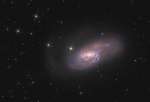 Spiral Galaxy M66
13.11.2010
Big beautiful spiral galaxy M66 lies a mere 35 million light-years away. About 100 thousand light-years across, the gorgeous island universe is well known to astronomers as a member of the Leo Triplet of galaxies.
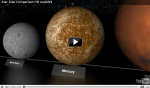 Star Size Comparisons
22.02.2011
How big is our Sun compared to other stars? In a dramatic and popular video featured on YouTube, the relative sizes of planets and stars are shown from smallest to largest. The above video starts with Earth's Moon and progresses through increasingly larger planets in our Solar System.
 A Starry Night of Iceland
17.05.2011
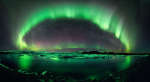
On some nights, the sky is the best show in town. On this night, the sky was not only the best show in town, but a composite image of the sky won an international competition for landscape astrophotography. The above winning image was taken two months ago over JЖkulsАrlСn, the largest glacial lake in Iceland.
 NGC 206 and the Star Clouds of Andromeda
24.10.2012
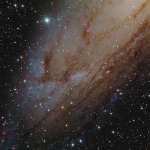
The large stellar association cataloged as NGC 206 is nestled within the dusty arms of neighboring spiral galaxy Andromeda (M31), 2.5 million light-years distant. Seen near the center of this gorgeous close-up of the southwestern extent of Andromeda's disk, the bright, blue stars of NGC 206 indicate its youth.
 Star Size Comparisons
6.06.2013
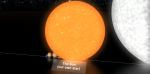
How big is our Sun compared to other stars? In a dramatic and popular video featured on YouTube, the relative sizes of planets and stars are shown from smallest to largest. The above video starts with Earth's Moon and progresses through increasingly larger planets in our Solar System.
 The Gum Nebula Expanse
24.05.2018
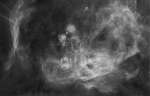
Named for a cosmic cloud hunter, Australian astronomer Colin Stanley Gum (1924-1960), The Gum Nebula is so large and close it is actually hard to see. In fact, we are only about 450 light-years from the front edge and 1,500 light-years from the back edge of this interstellar expanse of glowing hydrogen gas.
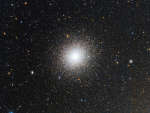 Globular Star Cluster 47 Tuc
24.10.2020
Globular star cluster 47 Tucanae is a jewel of the southern sky. Also known as NGC 104, it roams the halo of our Milky Way Galaxy along with some 200 other globular star clusters.
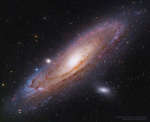 M31: The Andromeda Galaxy
19.01.2022
The most distant object easily visible to the unaided eye is M31, the great Andromeda Galaxy. Even at some two and a half million light-years distant, this immense spiral galaxy -- spanning over 200,000 light years -- is visible, although as a faint, nebulous cloud in the constellation Andromeda.
|
January February March April May June July August September October |
|||||||||||||||||||||||||||||||||||||||||||||||||