
|
You entered: Solar System
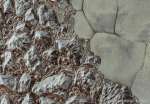 Pluto: From Mountains to Plains
14.12.2015
What do the sharpest views ever of Pluto show? As the robotic New Horizons spacecraft moves into the outer Solar System, it is now sending back some of the highest resolution images from its historic encounter with Pluto in July. Featured here is one recently-received, high-resolution image.
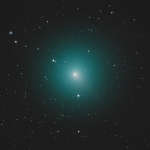 Comet 46P Wirtanen
15.11.2018
Periodic Comet 46P/Wirtanen is now the brightest comet in the night sky, but too faint to be seen by eye. From dark sky sites it could just become naked-eye visible though, as it's 5.4 year long looping orbit takes it closest to Earth and the Sun in mid December.
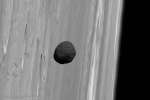 Martian Moon Phobos from Mars Express
8.11.2020
Why is Phobos so dark? Phobos, the largest and innermost of two Martian moons, is the darkest moon in the entire Solar System. Its unusual orbit and color indicate that it may be a captured asteroid composed of a mixture of ice and dark rock.
 APOD: 2023 June 25 Б Lightning on Jupiter
25.06.2023
Does lightning occur only on Earth? No. Spacecraft in our Solar System have detected lightning on other planets, including Mars, Jupiter and Saturn, and lightning is likely on Venus, Uranus, and Neptune. Lightning is a sudden rush of electrically charged particles from one location to another.
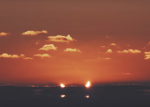 APOD: 2025 April 1 Б A Double Sunrise from a Partial Eclipse
1.04.2025
Can the Sun appear to rise twice at the same time? This was just the case a few days ago from Les Escoumins, Quebec, Canada as our Solar System's bright central orb rose just as it was being partially eclipsed by the Moon.
 Super Planet Crash
11.01.2015
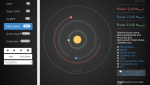
Can you create a planetary system that lasts for 500 years? Super Planet Crash, the featured game, allows you to try. To create up to ten planets, just click anywhere near the central star.
 Galileo's Jupiter Probe
7.12.1995
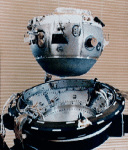
Today, at about 5:00 pm EST, this 750 pound probe from NASA's robot spacecraft Galileo will plummet into Jupiter becoming the first probe to fly through the atmosphere of a gas giant planet.
 Comet Kudo-Fujikawa: Days in the Sun
30.01.2003
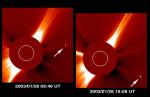
Cruising through the inner Solar System, new Comet Kudo-Fujikawa reached perihelion, its closest approach to the Sun, yesterday, January 29. Passing within 28.4 million kilometers of the Sun, this comet came much closer than innermost planet Mercury basking only 57.9 million kilometers from our parent star.
 A Robots Shadow on Asteroid Itokawa
16.11.2005
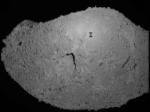
What's that unusual looking spot on asteroid Itokawa? It's the shadow of the robot spacecraft Hayabusa that took the image. Japan's Hayabusa mission arrived at the asteroid in early September and has been imaging and maneuvering around the floating space mountain ever since. The above picture was taken earlier this month.
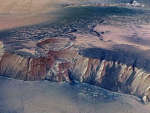 High Cliffs Surrounding Echus Chasma on Mars
23.07.2008
What created this great cliff on Mars? Did giant waterfalls once plummet through its grooves? With a four-kilometer drop, this high cliff surrounding Echus Chasma, near an impressive impact crater, was carved by either water or lava.
|
January February March April May June July August |
||||||||||||||||||||||||||||||||||||||||||||||||||||||||