
|
You entered: cluster
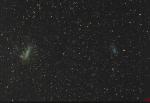 A Magellanic Mural
3.02.1998
Two galaxies stand out to casual observers in Earth's Southern Hemisphere: the Large Magellanic Cloud (LMC) and the Small Magellanic Cloud (SMC). These irregular galaxies are two of the closest galaxies to our Milky Way Galaxy.
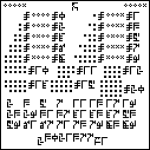 A Cosmic Call to Nearby Stars
2.04.2006
If you could send a message to an alien civilization, what would you say? The people from the Cosmic Call project sent the above image as the first page of a longer message. The message was broadcast toward local stars by radio telescope during the summer of 1999. Another message was sent in 2003.
 Iridescent by Moonlight
4.12.2021
In this snapshot from November 18, the Full Moon was not far from Earth's shadow. In skies over Sicily the brightest lunar phase was eclipsed by passing clouds though. The full moonlight was dimmed and momentarily diffracted by small but similar sized water droplets near the edges of the high thin clouds.
 NGC 1365: A Nearby Barred Spiral Galaxy
13.04.2003
Many spiral galaxies have bars across their centers. Even our own Milky Way Galaxy is thought to have a bar, but perhaps not so prominent as the one in NGC 1365, shown above. The persistence and motion of the bar imply relatively massive spiral arms.
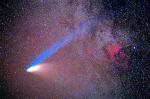 Hale Bopp and the North American Nebula
9.10.1997
Comet Hale-Bopp's recent encounter with the inner Solar System allowed many breath-taking pictures. Above, Comet Hale-Bopp was photographed on March 8th in the constellation of Cygnus. Visible on the right in red is the North American Nebula, a bright emission nebula observable from a dark location with binoculars.
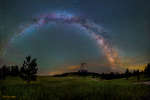 Milky Way over Devils Tower
30.10.2014
A mysterious formation known as Devils Tower rises into the dark above northeastern Wyoming's prairie landscape in this 16 frame panoramic view. Seen against the night sky's thin, pale clouds and eerie...
 IC 2944: The Running Chicken Nebula
20.04.2020
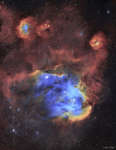
To some, it looks like a giant chicken running across the sky. To others, it looks like a gaseous nebula where star formation takes place. Cataloged as IC 2944, the Running Chicken Nebula spans about 100 light years and lies about 6,000 light years away toward the constellation of the Centaur (Centaurus).
 The Small Cloud of Magellan
19.07.1997
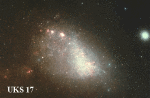
The southern sky contains wonders almost unknown in the north. These wonders include the Large and Small Magellanic Clouds: small irregular galaxies orbiting our own larger Milky Way spiral galaxy. The Small Magellanic Cloud (SMC), pictured here, is about 250,000 light years away.
 Stars from Eagle's EGGs
12.04.1998
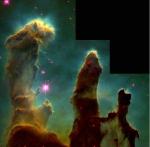
Newborn stars are forming in the Eagle Nebula. This image, taken with the Hubble Space Telescope in 1995, shows evaporating gaseous globules (EGGs) emerging from pillars of molecular hydrogen gas and dust. The giant pillars are light years in length and are so dense that interior gas contracts gravitationally to form stars.
 Moon in the Hyades
20.04.2018
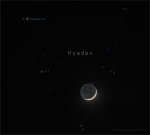
Have you seen the Moon lately? On April 18, its waxing sunlit crescent moved through planet Earth's night across a background of stars in the Hyades. Anchored by bright star Aldebaran, the nearby, V-shaped star cluster and complete lunar orb appear in this telephoto image.
|
January February March April May June July August September October |
|||||||||||||||||||||||||||||||||||||||||||||||||