
|
You entered: constellation
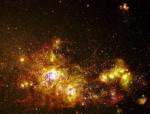 NGC 4214: Star Forming Galaxy
7.01.2000
Dazzling displays of star formation abound across the face of galaxy NGC 4214, a mere 13 million light-years away in the northern constellation Canes Venatici. While this 1997 Hubble Space Telescope image shows...
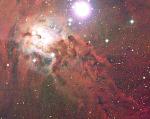 The Fox Fur Nebula
1.07.2002
The nebula surrounding bright star S Mon is filled with dark dust and glowing gas. The strange shapes that surrounding this star originate from fine interstellar dust reacting in complex ways with the energetic light and hot gas being expelled by the young stars.
 A Sonic Boom
4.05.2003
Many people have heard a sonic boom, but few have seen one. When an airplane travels at a speed faster than sound, density waves of sound emitted by the plane cannot precede the plane, and so accumulate in a cone behind the plane.
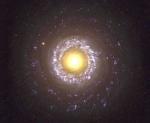 Spiral Galaxy NGC 7742
26.07.2003
This might resemble a fried egg you've had for breakfast, but it's actually much larger. In fact, ringed by blue-tinted star forming regions and faintly visible spiral arms, the yolk-yellow center of this face-on spiral galaxy, NGC 7742, is about 3,000 light-years across.
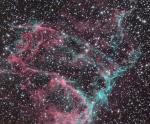 IC1340 in the Eastern Veil
26.09.2003
These ghostly filaments of interstellar gas are just a small part of the expansive Veil Nebula, seen against a rich field of background stars in the long-necked constellation Cygnus. Also known as the Cygnus...
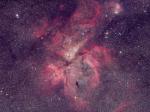 NGC 3372: The Great Nebula in Carina
17.05.2004
In one of the brightest parts of the Milky Way lies a nebula where some of the oddest things occur. NGC 3372, known as the Great Nebula in Carina, is home to massive stars and changing nebula.
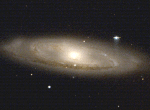 M65 Without Moth
7.08.1998
Messier 65 (M65) is a bright spiral galaxy of stars only 35 million light-years away in the constellation Leo. With very tightly wound spiral arms, a large central bulge, and well defined dust lanes, this galaxy is a member of a group of galaxies known as the Leo triplet.
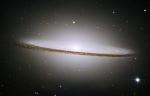 The Sombrero Galaxy from HST
15.01.2006
Why does the Sombrero Galaxy look like a hat? Reasons include the Sombrero's unusually large and extended central bulge of stars, and dark prominent dust lanes that appear in a disk that we see nearly edge-on. Billions of old stars cause the diffuse glow of the extended central bulge.
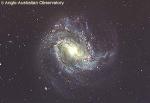 M83: A Barred Spiral Galaxy
26.09.1999
M83 is a bright spiral galaxy that can be found with a small telescope in the constellation of Hydra. It takes light about 15 million years to reach us from M83. M83 is quite a typical spiral - much like our own Milky Way Galaxy.
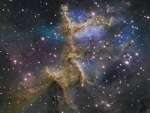 Central IC 1805
26.07.2008
Cosmic clouds seem to form fantastic shapes in the central regions of emission nebula IC 1805. Of course, the clouds are sculpted by stellar winds and radiation from massive hot stars in the nebula's newborn star cluster (aka Melotte 15).
|
January February March April May June July August September October |
|||||||||||||||||||||||||||||||||||||||||||||||||