
|
You entered: dark cloud
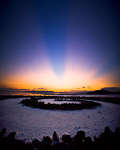 Sunset at the Spiral Jetty
4.12.2010
In dwindling twilight at an August day's end, these broad dark bands appeared in the sky for a moment, seen from Robert Smithson's Spiral Jetty on the eastern shore of Utah's Great Salt Lake.
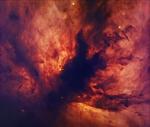 Flame Nebula Close Up
2.02.2007
Of course, the Flame Nebula is not on fire. Also known as NGC 2024, the nebula's suggestive reddish color is due to the glow of hydrogen atoms at the edge of the giant Orion molecular cloud complex some 1,500 light-years away.
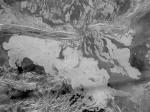 Lava Flows on Venus
23.03.2004
The hot surface of Venus shows clear signs of ancient lava flows. Evidence of this was bolstered by the robot spacecraft Magellan, which orbited Venus in the early 1990s. Using imaging radar, Magellan was able to peer beneath the thick perpetual clouds that cover Earth's closest planetary neighbor.
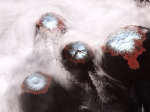 Islands of Four Mountains from Above
22.06.2010
Our Earth is covered by volcanoes. Volcanoes are breaks in the Earth's cool surface where hot liquid rock from the interior comes out -- sometimes suddenly. In the above image from the ASTER camera...
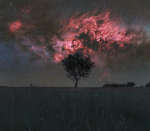 APOD: 2026 March 18 Б Cygnus and the Solitary Tree
18.03.2026
A lone tree stands in a quiet meadow in Guadalajara, Spain, silhouetted against the Cygnus region rising above like flames in the night sky. This deep night skyscape is a composite of exposures that reveals a range of brightness and color human eyes can't quite see on their own.
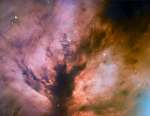 Flame Nebula Close Up
26.11.2010
Of course, the Flame Nebula is not on fire. Also known as NGC 2024, the nebula's suggestive reddish color is due to the glow of hydrogen atoms at the edge of the giant Orion molecular cloud complex some 1,500 light-years away.
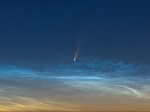 Comet NEOWISE Rising over the Adriatic Sea
13.07.2020
This sight was worth getting out of bed early. Comet C/2020 F3 (NEOWISE) has been rising before dawn during the past week to the delight of northern sky enthusiasts awake that early. Up before...
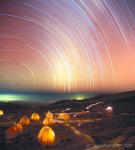 The Star Trails of Kilimanjaro
7.03.2003
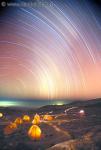
The night had no moon, but the stars were out. And camped at 16,000 feet on Mt. Kilimanjaro, photographer Dan Heller recorded this marvelous 3 1/2 hour long exposure. Here the landscape is lit mostly by the stars.
 The Star Trails of Kilimanjaro
11.09.2004
The night had no moon, but the stars were out. And camped at 16,000 feet on Mt. Kilimanjaro, photographer Dan Heller recorded this marvelous 3 1/2 hour long exposure. Here the landscape is lit mostly by the stars.
 A Witch by Starlight
31.10.2008
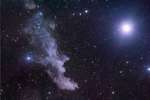
By starlight this eerie visage shines in the dark, a crooked profile evoking its popular name, the Witch Head Nebula. In fact, this entrancing telescopic portrait gives the impression the witch has fixed her gaze on Orion's bright supergiant star Rigel.
|
January February March April May June July August September October |
|||||||||||||||||||||||||||||||||||||||||||||||||