
|
You entered: nearest stars
 APOD: 2024 January 7 Б The Cats Eye Nebula in Optical and X-ray
7.01.2024
To some it looks like a cat's eye. To others, perhaps like a giant cosmic conch shell. It is actually one of the brightest and most highly detailed planetary nebula known, composed of gas expelled in the brief yet glorious phase near the end of life of a Sun-like star.
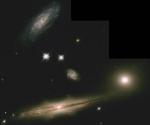 HCG 87: A Small Group of Galaxies
6.09.1999
Sometimes galaxies form groups. For example, our own Milky Way Galaxy is part of the Local Group of Galaxies. Small, compact groups, like Hickson Compact Group 87 (HCG 87) shown above, are interesting partly because they slowly self-destruct.
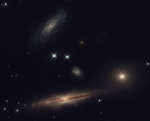 HCG 87: A Small Group of Galaxies
6.07.2010
Sometimes galaxies form groups. For example, our own Milky Way Galaxy is part of the Local Group of Galaxies. Small, compact groups, like Hickson Compact Group 87 (HCG 87) shown above, are interesting partly because they slowly self-destruct.
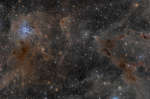 The Iris Nebula in a Field of Dust
12.09.2019
These cosmic dust clouds drift some 1,300 light-years away along the fertile starfields of the constellation Cepheus. The beautiful Iris Nebula, also known as NGC 7023, blossoms at the upper left. Not the only nebula in the sky to evoke the imagery of flowers, its pretty, symmetric form spans about 6 light-years.
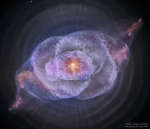 The Cats Eye Nebula in Optical and X-ray
7.11.2021
To some it looks like a cat's eye. To others, perhaps like a giant cosmic conch shell. It is actually one of brightest and most highly detailed planetary nebula known, composed of gas expelled in the brief yet glorious phase near the end of life of a Sun-like star.
 Stars Forming in Serpens
31.08.2007
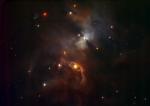
Stars are forming in a dense molecular cloud a mere 1,000 light-years away in the constellation Serpens Cauda (The Serpent's Tail). At that estimated distance, this sharp, near-infrared close-up of the active Serpens star-forming region spans about 2 arcminutes or just over half a light-year.
 Cygnus Without Stars
24.04.2008
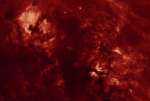
The sky is full of hydrogen, though it can take a sensitive camera and telescope to see it. For example, this twelve-degree-wide view of the northern part of the constellation Cygnus reveals cosmic clouds of hydrogen gas along the plane of our Milky Way galaxy.
 The Butterfly Nebula from Upgraded Hubble
10.09.2009
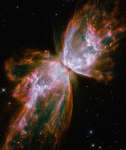
The bright clusters and nebulae of planet Earth's night sky are often named for flowers or insects, and NGC 6302 is no exception. With an estimated surface temperature of about 250,000 degrees...
 M7: Open Star Cluster in Scorpius
13.07.2016
M7 is one of the most prominent open clusters of stars on the sky. The cluster, dominated by bright blue stars, can be seen with the naked eye in a dark sky in the tail of the constellation of the Scorpion (Scorpius).
 NGC 6302: Big, Bright, Bug Nebula
29.04.2007
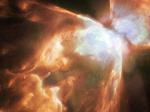
The bright clusters and nebulae of planet Earth's night sky are often named for flowers or insects, and NGC 6302 is no exception. With an estimated surface temperature of about 250,000 degrees...
|
January February March April May June July August September |
|||||||||||||||||||||||||||||||||||||||||||||||||