
|
You entered: sky
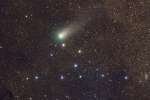 Comet Garradd and the Coat Hanger
9.09.2011
Sweeping through planet Earth's night sky, last weekend Comet Garradd (C/2009 P1) visited this lovely star field along the Milky Way in the constellation Vulpecula. Suggestively oriented, the colorful skyscape features stars in the asterism known as the Coat Hanger with the comet's tail pointing toward the southeast.
 Milky Way over Trolls Tongue
11.09.2018
You have to take a long hike to see the Troll's Tongue -- ten hours over rocky terrain. And in this case, it took three trips to capture the landform below a clear night sky. Trolltunga itself is a picturesque rock protrusion extending about 700 meters over mountainous cliffs near Lake Ringedalsvatnet in Norway.
 A Partial Solar Eclipse Sequence Reflected
27.12.2019
What's happened to the Sun? Yesterday, if you were in the right place at the right time, you could see the Sun rise partially eclipsed by the Moon. The unusual sight was captured...
 APOD: 2024 February 5 Б In the Core of the Carina Nebula
5.02.2024
What's happening in the core of the Carina Nebula? Stars are forming, dying, and leaving an impressive tapestry of dark dusty filaments. The entire Carina Nebula, cataloged as NGC 3372, spans over 300 light years and lies about 8,500 light-years away in the constellation of Carina.
 APOD: 2024 February 21 Б Seagull Nebula over Pinnacles Peak
21.02.2024
The bird is bigger than the peak. Nicknamed for its avian shape, the Seagull Nebula is an emission nebula on the night sky that is vast, spanning an angle over five times the diameter of the full moon and over 200 light years.
 APOD: 2025 October 20 Б Finding Comet Lemmon
20.10.2025
Tonight, if you can see the stars of the Big Dipper, then you can find comet Lemmon in your evening sky. After sunset, look for the faint but extended comet above your northwestern horizon -- but below the handle of the famous celestial kitchen utensil of the north.
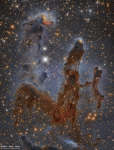 APOD: 2026 May 31 Б Eagle Nebula Pillars in Infrared from Hubble
31.05.2026
Newborn stars are forming in the Eagle Nebula. They are gravitationally contracting in pillars of dense gas and dust. The intense radiation of these newly-formed bright stars is causing surrounding material to boil away.
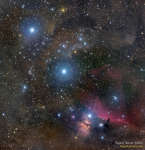 Alnitak, Alnilam, Mintaka
12.12.2013
Alnitak, Alnilam, and Mintaka, are the bright bluish stars from east to west (lower right to upper left) along the diagonal in this gorgeous cosmic vista. Otherwise known as the Belt of Orion, these three blue supergiant stars are hotter and much more massive than the Sun.
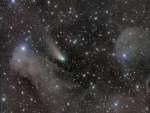 Outbound Comet ZTF
24.03.2023
Former darling of the northern sky Comet C/2022E3 (ZTF) has faded. During its closest approach to our fair planet in early February Comet ZTF was a mere 2.3 light-minutes distant. Then known as the green comet, this visitor from the remote Oort Cloud is now nearly 13.3 light-minutes away.
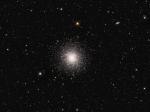 M13: The Great Globular Cluster in Hercules
18.05.2007
In 1714, Edmond Halley noted that M13 "shows itself to the naked eye when the sky is serene and the Moon absent." Of course, M13 is now modestly recognized as the Great Globular Cluster in Hercules, one of the brightest globular star clusters in the northern sky.
|
January February March April May June July August September October |
|||||||||||||||||||||||||||||||||||||||||||||||||