
|
You entered: Earth
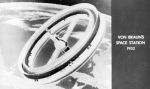 Von Braun's Wheel
2.03.1996
Orbiting 1,075 miles above the Earth, a 250 foot wide, inflated, reinforced nylon "wheel" was conceived in the early 1950s to function as a navigational aid, meteorological station, military platform, and way station for space exploration by rocket pioneer Wernher von Braun.
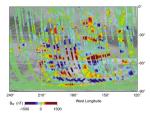 Magnetic Mars
4.05.1999
Mapping Mars from orbit, instruments on the Mars Global Surveyor (MGS) spacecraft have recently revealed banded magnetic field patterns - a startling and unanticipated suggestion that the Red Planet was more Earth-like in its distant past.
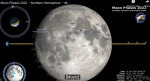 Moon Phases 2022
1.02.2022
What will the Moon phase be on your birthday this year? It is hard to predict because the Moon's appearance changes nightly. As the Moon orbits the Earth, the half illuminated by the Sun first becomes increasingly visible, then decreasingly visible.
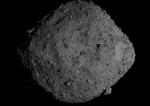 Descending Toward Asteroid Bennu
12.10.2020
What would it be like to land on an asteroid? Although no human has yet done it, NASA's robotic OSIRIS-REx spacecraft is scheduled to attempt to touch the surface of asteroid 101955 Bennu next week.
 The Astronaut Who Captured a Satellite
9.12.2012
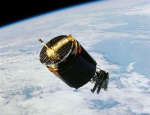
In 1984, high above the Earth's surface, an astronaut captured a satellite. It was the second satellite captured that mission. Pictured above, astronaut Dale A. Gardner flies free using the Manned Maneuvering Unit and begins to attach a control device dubbed the Stinger to the rotating Westar 6 satellite.
 APOD: 2023 January 9 Б Tails of Comet ZTF
9.01.2023
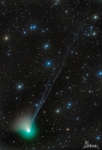
Comet ZTF may become visible to the unaided eye. Discovered early last year, this massive snowball has been brightening as it approaches the Sun and the Earth. C/2022 E3 (ZTF) will be closest...
 Little Planet Aurora
25.11.2023
Immersed in an eerie greenish light, this rugged little planet appears to be home to stunning water falls and an impossibly tall mountain. It's planet Earth of course. On the night of November 9 the nadir-centered 360 degree mosaic was captured by digital camera from the Kirkjufell mountain area of western Iceland.
 Mercury and Crescent Moon Set
15.04.2016
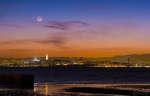
Innermost planet Mercury and a thin crescent Moon are never found far from the Sun in planet Earth's skies. Taken near dusk on April 8, this colorful evening skyscape shows them both setting toward the western horizon just after the Sun.
 A Perseid Below
9.08.2024
Denizens of planet Earth typically watch meteor showers by looking up. But this remarkable view, captured on August 13, 2011 by astronaut Ron Garan, caught a Perseid meteor by looking down. From Garan...
 APOD: 2025 August 21 Б Mostly Perseids
21.08.2025
In this predawn skyscape recorded during the early morning hours of August 13, mostly Perseid meteors are raining down on planet Earth. You can easily identify the Perseid meteor streaks. They're the ones...
|
January February March April May June July August September October |
|||||||||||||||||||||||||||||||||||||||||||||||||