
|
You entered: Earth orbit
 Between the Rings
21.04.2017
On April 12, as the Sun was blocked by the disk of Saturn the Cassini spacecraft camera looked toward the inner Solar System and the gas giant's backlit rings. At the top of the mosaicked view is the A ring with its broader Encke and narrower Keeler gaps visible.
 Lunar Orbiter Earthset
26.08.2016
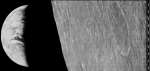
August 10th was the 50th anniversary of the launch of Lunar Orbiter 1. It was the first of five Lunar Orbiters intended to photograph the Moon's surface to aid in the selection of future landing sites.
 Spacecraft Rosetta Shows Comet has Two Components
21.07.2014
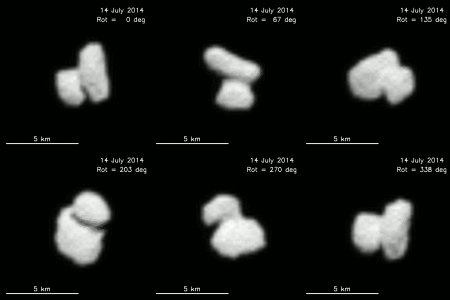
Why does this comet's nucleus have two components? The surprising discovery that Comet 67P/ChuryumovGerasimenko has a double nucleus came late last week as ESA's robotic interplanetary spacecraft Rosetta continued its approach toward the ancient comet's core.
 Stars Without Galaxies
18.01.2002
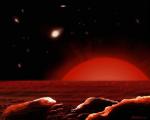
Galaxies are made up of stars, but are all stars found within galaxies? Using the Hubble Space Telescope, researchers exploring the Virgo Cluster of galaxies have found about 600 red giant stars adrift in intergalactic space. Above is an artist's vision of the sky from a hypothetical planet of such a lonely sun.
 Layered Hills on Mars
23.12.2003
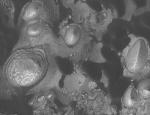
Why are some hills on Mars so layered? The answer is still under investigation. Clearly, dark windblown sand surrounds outcropping of light sedimentary rock across the floor of crater Arabia Terra. The light rock clearly appears structured into many layers, the lowest of which is likely very old.
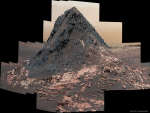 Ireson Hill on Mars
18.07.2017
What created this unusual hill on Mars? Its history has become a topic of research, but its shape and two-tone structure makes it one of the more unusual hills that the robotic Curiosity rover on Mars has rolled near. Dubbed Ireson Hill, the mound rises about 5 meters high and spans about 15 meters across.
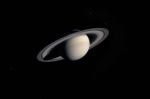 Cassini Approaches Saturn
9.12.2003
Cassini, a robot spacecraft launched in 1997 by NASA, is close enough now to resolve many rings and moons of its destination planet: Saturn. The spacecraft has now closed to within a single Earth-Sun separation from the ringed giant. Early last month, Cassini snapped the contrast-enhanced color composite pictured above.
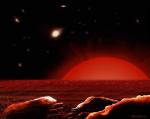 Stars Without Galaxies
14.02.1998
Galaxies are made up of stars, but are all stars found within galaxies? Using the Hubble Space Telescope, researchers exploring the Virgo Cluster of galaxies have now found about 600 red giant stars adrift in intergalactic space. Above is an artist's vision of the sky from a hypothetical planet of such a lonely sun.
 Epimetheus and Janus: Interchangeable Moons of Saturn
1.11.2005
These two moons change places. Epimetheus and Janus, two small moons of Saturn, actually switch positions as they orbit their home planet. The orbital radii of the moons are strangely separated by less than the radii of the moons themselves: about 50 kilometers. One moon orbits Saturn well ahead of the other, at first.
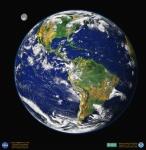 Big Blue Marble Earth
26.04.2003
This reconstructed digital portrait of our planet is reminiscent of the Apollo-era pictures of the "big blue marble" Earth from space. To create it, researchers at Goddard Space Flight Center's Laboratory for Atmospheres...
|
January February March April May June July August September October |
|||||||||||||||||||||||||||||||||||||||||||||||||