
|
You entered: clouds
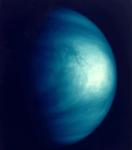 Venus: Just Passing By
12.06.1999
Venus, the second closest planet to the Sun, is a popular way-point for spacecraft headed for the gas giant planets in the outer reaches of the solar system. Why visit Venus first? Using...
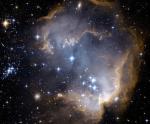 NGC 602 and Beyond
10.01.2007
Near the outskirts of the Small Magellanic Cloud, a satellite galaxy some 200 thousand light-years distant, lies 5 million year young star cluster NGC 602. Surrounded by natal gas and dust, NGC 602 is featured in this stunning Hubble image of the region.
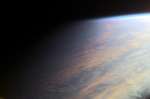 Earth at Twilight
27.12.2007
No sudden, sharp boundary marks the passage of day into night in this gorgeous view of ocean and clouds over our fair planet Earth. Instead, the shadow line or terminator is diffuse and shows the gradual transition to darkness we experience as twilight.
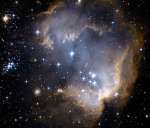 NGC 602 and Beyond
3.04.2010
Near the outskirts of the Small Magellanic Cloud, a satellite galaxy some 200 thousand light-years distant, lies 5 million year young star cluster NGC 602. Surrounded by natal gas and dust, NGC 602 is featured in this stunning Hubble image of the region.
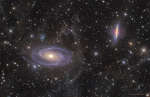 M81 versus M82
25.09.2013
Here in the Milky Way galaxy we have astronomical front row seats as M81 and M82 face-off, a mere 12 million light-years away. Locked in a gravitational struggle for the past billion years or so, the two bright galaxies are captured in this deep telescopic snapshot, constructed from 25 hours of image data.
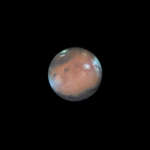 Mars near Opposition
11.04.2014
Tonight Mars is between opposition (April 8) and closest approach (April 14) looping through the constellation Virgo opposite the Sun in the night sky. That makes it prime season for telescopic views of the the Red Planet, like this one from April 3rd.
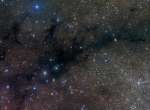 LDN 988 and Friends
24.09.2015
Stars are forming in dark, dusty molecular cloud LDN 988. Seen near picture center some 2,000 light-years distant, LDN 988 and other nearby dark nebulae were cataloged by Beverly T. Lynds in 1962 using Palomar Observatory Sky Survey plates.
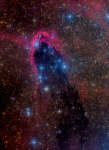 The Dark Tower in Scorpius
15.07.2021
In silhouette against a crowded star field along the tail of the arachnalogical constellation Scorpius, this dusty cosmic cloud evokes for some the image of an ominous dark tower. In fact, clumps of dust...
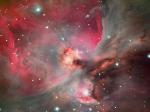 The Great Nebula in Orion
13.02.2002
Few astronomical sights excite the imagination like the nearby stellar nursery known as the Orion Nebula. The Nebula's glowing gas surrounds hot young stars at the edge of an immense interstellar molecular cloud only 1500 light-years away.
 The Tarantula Zone
26.04.2008
The Tarantula Nebula is more than 1,000 light-years in diameter -- a giant star forming region within our neighboring galaxy the Large Magellanic Cloud (LMC). That cosmic arachnid lies at the upper left of this expansive mosiac covering a part of the LMC over 6,000 light-years across.
|
January February March April May June July August September October |
|||||||||||||||||||||||||||||||||||||||||||||||||