
|
You entered: galaxy cluster
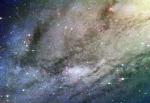 Southwest Andromeda
17.09.2001
This new image composite of the southwest region of M31 from the Subaru Telescope shows many stars, nebulae, and star clusters never before resolved. An older population of stars near Andromeda's center causes the yellow hue visible on the upper right. Young blue stars stand out in the spiral arms on the lower left.
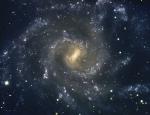 The Arms of NGC 7424
16.12.2004
The grand, winding arms are almost mesmerizing in this face-on view of NGC 7424, a spiral galaxy with a prominent central bar. About 40 million light-years distant in the headlong constellation Grus, this island universe is also about 100,000 light-years across making it remarkably similar to our own Milky Way.
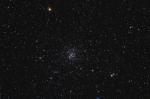 Star Cluster Messier 67
9.08.2007
Gathered at the center of this sharp skyview are the stars of Messier 67, one of the oldest known open star clusters. In fact, though open star clusters are usually much younger, the stars...
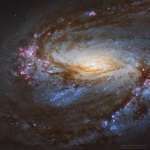 Messier 66 Close Up
28.01.2021
Big, beautiful spiral galaxy Messier 66 lies a mere 35 million light-years away. The gorgeous island universe is about 100 thousand light-years across, similar in size to the Milky Way. This reprocessed Hubble Space Telescope close-up view spans a region about 30,000 light-years wide around the galactic core.
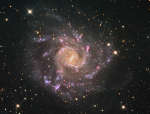 Grand Spiral Galaxy NGC 7424
8.01.2013
The grand, winding arms are almost mesmerizing in this face-on view of NGC 7424, a spiral galaxy with a prominent central bar. About 40 million light-years distant in the headlong constellation Grus, this island universe is also about 100,000 light-years across making it remarkably similar to our own Milky Way.
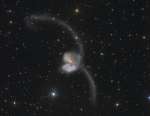 The Antennae
29.04.2011
Some 60 million light-years away in the southerly constellation Corvus, two large galaxies collided. But the stars in the two galaxies, cataloged as NGC 4038 and NGC 4039, don't collide in the course of the ponderous event, lasting hundreds of millions of years.
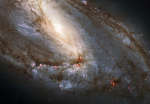 Messier 66 Close Up
13.06.2024
Big, beautiful spiral galaxy Messier 66 lies a mere 35 million light-years away. The gorgeous island universe is about 100 thousand light-years across, similar in size to the Milky Way. This Hubble Space Telescope close-up view spans a region about 30,000 light-years wide around the galactic core.
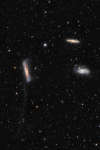 The Tidal Tail of NGC 3628
6.07.2012
A mere 30 million light-years away, large spiral galaxy NGC 3628 (center left) shares its neighborhood in the local Universe with two other large spirals, in a magnificent grouping otherwise known as the Leo Triplet.
 The Tidal Tail of NGC 3628
27.07.2007
A mere 30 million light-years away, large spiral galaxy NGC 3628 (center) shares its neighborhood in the local Universe with two other large spirals, in a magnificent grouping otherwise known as the Leo Triplett.
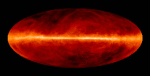 A Sky Full Of Hydrogen
18.12.1996
Interstellar space is filled with extremely tenuous clouds of gas which are mostly Hydrogen. The neutral hydrogen atom (HI in astronomer's shorthand) consists of 1 proton and 1 electron. The proton and electron spin like tops but can have only two orientations; spin axes parallel or anti-parallel.
|
January February March April May June July August September October |
|||||||||||||||||||||||||||||||||||||||||||||||||