
|
You entered: young stars
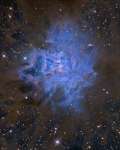 NGC 7023: The Iris Nebula
29.09.2012
Like delicate cosmic petals, these clouds of interstellar dust and gas have blossomed 1,300 light-years away in the fertile star fields of the constellation Cepheus. Sometimes called the Iris Nebula and dutifully cataloged as NGC 7023 this is not the only nebula in the sky to evoke the imagery of flowers.
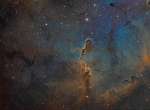 The Elephant s Trunk in IC 1396
26.07.2013
Like an illustration in a galactic Just So Story, the Elephant's Trunk Nebula winds through the emission nebula and young star cluster complex IC 1396, in the high and far off constellation of Cepheus. Of course, the cosmic elephant's trunk is over 20 light-years long.
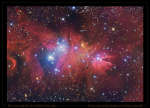 A Fox Fur, a Unicorn, and a Christmas Tree
6.04.2010
What do the following things have in common: a cone, the fur of a fox, and a Christmas tree? Answer: they all occur in the constellation of the unicorn (Monoceros). Pictured above...
 APOD: 2025 April 20 Б The Orion Nebula in Visible and Infrared
20.04.2025
The Great Nebula in Orion is a colorful place. Visible to the unaided eye, it appears as a small fuzzy patch in the constellation of Orion. Long exposure, multi-wavelength images like this, however, show the Orion Nebula to be a busy neighborhood of young stars, hot gas, and dark dust.
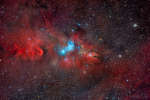 Fox Fur, Unicorn, and Christmas Tree
26.12.2020
Clouds of glowing hydrogen gas fill this colorful skyscape in the faint but fanciful constellation Monoceros, the Unicorn. A star forming region cataloged as NGC 2264, the complex jumble of cosmic gas and dust...
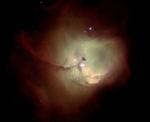 N81: Star Cradle in the SMC
5.10.2000
This dramatic Hubble Space Telescope image captures the birth of a cluster of massive stars. The newborn stars are seen just as they emerge from their natal nebula. Only 12 light-years across, the nebula...
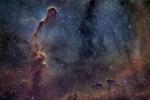 The Elephant s Trunk in IC 1396
18.10.2007
Like an illustration in a galactic Just So Story, the Elephant's Trunk Nebula winds through the emission nebula and young star cluster complex IC 1396, in the high and far off constellation of Cepheus. Of course, this cosmic elephant's trunk is over 20 light-years long.
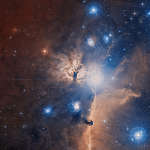 Inside the Flame Nebula
2.11.2019
The Flame Nebula stands out in this optical image of the dusty, crowded star forming regions toward Orion's belt, a mere 1,400 light-years away. X-ray data from the Chandra Observatory and infrared images from the Spitzer Space Telescope can take you inside the glowing gas and obscuring dust clouds though.
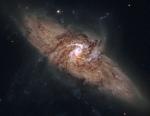 NGC 3314: When Galaxies Overlap
11.05.2000
Can this be a spiral galaxy? In fact, NGC 3314 consists of two large spiral galaxies which just happen to almost exactly line-up. The foreground spiral is viewed nearly face-on, its pinwheel shape defined by young bright star clusters.
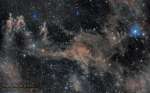 Stardust in Aries
9.12.2017
This composition in stardust covers over 8 degrees on the northern sky. The mosaicked field of view is west of the familiar Pleiades star cluster, toward the zodiacal constellation Aries and the plane of our Milky Way Galaxy.
|
January February March April May June July August September October |
|||||||||||||||||||||||||||||||||||||||||||||||||