
|
You entered: Milky Way
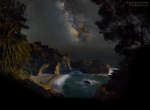 Galaxy Cove Vista Revisited
29.06.2014
To see a vista like this takes patience, hiking, and a camera. Patience was needed in searching out just the right place and waiting for just the right time. A short hike was needed to reach this rugged perch above a secluded cove in Julia Pfeiffer Burns State Park in California, USA.
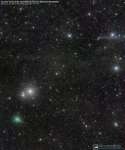 A Conjunction of Comets
23.09.2017
A conjunction of comets is captured in this pretty star field from the morning of September 17. Discovered in July by a robotic sky survey searching for supernovae, comet C/2017 O1 ASASSN is at the lower left. The visible greenish glow of its coma is produced by the fluorescence of diatomic carbon molecules in sunlight.
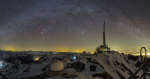 Pic du Midi Panorama
7.03.2020
A surreal night skyscape, this panorama stitched from 12 photos looks to the west at an evening winter sky over Pic du Midi Observatory, Pyrenees Mountains, Planet Earth. Telescope domes and a tall communications tower inhabit the rugged foreground.
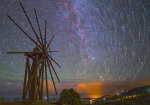 The Windmill and the Star Trails
17.04.2020
Stars can't turn these old wooden arms, but it does look like they might in this scene from a rotating planet. The well-composed night skyscape was recorded from Garafia, a municipality on the island of La Palma, Canary Islands, planet Earth.
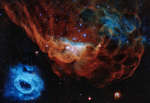 Hubble s Cosmic Reef
25.04.2020
These bright ridges of interstellar gas and dust are bathed in energetic starlight. With its sea of young stars, the massive star-forming region NGC 2014 has been dubbed the Cosmic Reef. Drifting just...
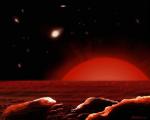 Stars Without Galaxies
19.01.2002
Galaxies are made up of stars, but are all stars found within galaxies? Using the Hubble Space Telescope, researchers exploring the Virgo Cluster of galaxies have found about 600 red giant stars adrift in intergalactic space. Above is an artist's vision of the sky from a hypothetical planet of such a lonely sun.
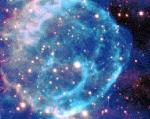 A Wolf-Rayet Star Blows Bubbles
3.01.1997
Wolf-Rayet stars can blow bubbles. These unusual stars are much hotter and more luminous than our Sun. All extremely massive stars will eventually evolve though a Wolf-Rayet phase. Approximately 200 Wolf-Rayet stars are known in our Milky Way Galaxy. Wolf-Rayet stars generate bubbles because they continually eject their outer atmosphere as a stellar wind.
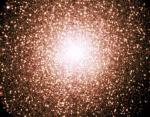 Globular Cluster 47 Tucanae from SALT
5.09.2005
Stars come in bunches. Of the over 200 globular star clusters that orbit the center of our Milky Way Galaxy, 47 Tucanae is the second brightest globular cluster, behind Omega Centauri. Known to some affectionately as 47 Tuc or NGC 104, it is only visible from Earth's Southern Hemisphere.
 Messier 88
30.01.2010
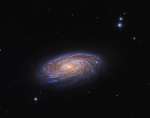
Charles Messier described the 88th entry in his 18th century catalog of Nebulae and Star Clusters as a spiral nebula without stars. Of course the gorgeous M88 is now understood to be a galaxy full of stars, gas, and dust, not unlike our own Milky Way.
 Zodiacal Light and the False Dawn
16.01.2012
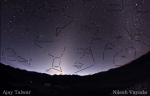
Is it dawn or false dawn? During certain times of the year, the horizon near the rising Sun will begin to glow unusually early. This early glow does not originate directly from the Sun, but rather from sunlight reflected by interplanetary dust.
|
January February March April May June July August September October |
|||||||||||||||||||||||||||||||||||||||||||||||||