
|
You entered: Solar System
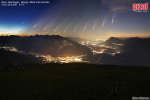 Comet NEOWISE over the Swiss Alps
15.07.2020
Comet NEOWISE has been wowing photographers around much of the world during dawn and dusk, at the margins of day and night. For the most northern residents of planet Earth, however, the comet circles the North Star and never sets.
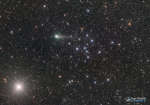 Comet C 2017 K2 (PanSTARRS)
30.06.2022
Imaged on June 20 2022, comet C/2017 K2 (PanSTARRS) shares this wide telescopic field of view with open star cluster IC 4665 and bright star Beta Ophiuchi, near a starry edge of the Milky Way.
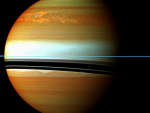 A Raging Storm System on Saturn
26.12.2011
It is one of the largest and longest lived storms ever recorded in our Solar System. First seen late last year, the above cloud formation in the northern hemisphere of Saturn started larger than the Earth and soon spread completely around the planet.
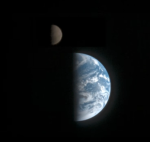 Earth and Moon
4.12.2017
On rare occasions, the Earth and Moon are photographed together. One of most spectacular times this occurred was 25 years ago this month when the Jupiter-bound Galileo spacecraft zoomed past our home planetary system. Then, robotic Galileo watched from about 15-times the Earth-Moon separation as our only natural satellite glided past our home world.
 Crater On Ice
14.07.2000
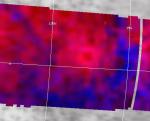
Impact craters are common on Earth's moon but on Jupiter's large ice moon Europa, they are very rare. Over time, both bodies have been subjected to an intense pounding by the solar system's formative debris, but geological activity on Europa's surface seems to have erased most of these impact scars.
 Orionids Meteor Shower to Peak Tonight
21.10.1996
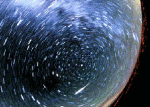
Tonight you might be able to see Halley's Comet again - or at least some pieces of it. It is widely thought that that the meteors from the Orionids meteor shower, which peaks tonight, are just small pieces of Halley's Comet falling to Earth.
 X Ray Rings Expand from a Gamma Ray Burst
30.01.2004
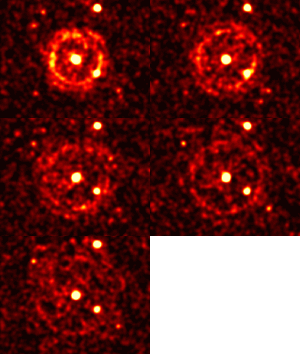
Why do x-ray rings appear to emanate from a gamma-ray burst? The surprising answer has little to do with the explosion itself but rather with light reflected off sheets of dust-laden gas in our own Milky Way Galaxy.
 Comet Lulin Tails
7.02.2009
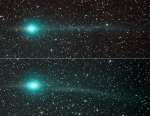
Sweeping through the inner solar system, Comet Lulin is easily visible in both northern and southern hemispheres with binoculars or a small telescope. Recent changes in Lulin's lovely greenish coma and tails are featured in this two panel comparison of images taken on January 31st (top) and February 4th.
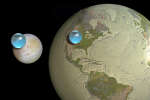 All the Water on Europa
24.05.2012
How much of Jupiter's moon Europa is made of water? A lot, actually. Based on the Galileo probe data acquired during its exploration of the Jovian system from 1995 to 2003, Europa posses a deep, global ocean of liquid water beneath a layer of surface ice.
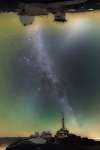 Crossing Horizons
25.11.2017
Follow this vertical panoramic view from horizon to horizon and your gaze will sweep through the zenith of a dark night sky over Pic du Midi mountaintop observatory. To make the journey above...
|
January February March April May June July August |
||||||||||||||||||||||||||||||||||||||||||||||||||||||||