
|
You entered: image
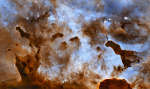 Dark Clouds of the Carina Nebula
19.09.2010
What dark forms lurk in the mists of the Carina Nebula? These ominous figures are actually molecular clouds, knots of molecular gas and dust so thick they have become opaque. In comparison, however, these clouds are typically much less dense than Earth's atmosphere.
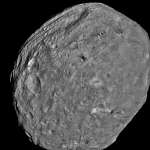 Asteroid Vesta Full Frame
2.08.2011
Why is the northern half of asteroid Vesta more heavily cratered than the south? No one is yet sure. This unexpected mystery has come to light only in the past few weeks since the robotic Dawn mission became the first spacecraft to orbit the second largest object in the asteroid belt between Mars and Jupiter.
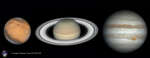 Three Planets from Pic du Midi
2.06.2016
Seen any planets lately? All three planets now shining brightly in the night sky are imaged in these panels, captured last week with the 1 meter telescope at Pic du Midi Observatory in the French Pyrenees.
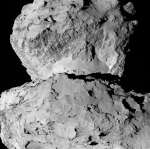 Contrasting Terrains on Comet Churyumov Gerasimenko
19.08.2014
Where should Philae land? As ESA's robotic spacecraft Rosetta circles toward Comet 67P/ Churyumov-Gerasimenko, a decision must eventually be made as to where its mechanical lander should attempt to touch-down. Reaching the comet...
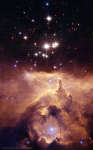 NGC 6357: Cathedral to Massive Stars
30.08.2020
How massive can a normal star be? Estimates made from distance, brightness and standard solar models had given one star in the open cluster Pismis 24 over 200 times the mass of our Sun, making it one of the most massive stars known.
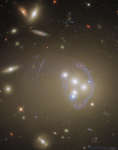 Abell 3827: Cannibal Cluster Gravitational Lens
23.08.2021
Is that one galaxy or three? Toward the right of the featured Hubble image of the massive galaxy cluster Abell 3827 is what appears to be a most unusual galaxy -- curved and with three centers.
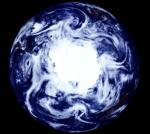 Summer at the South Pole
22.12.2002
The December solstice brings the beginning of Winter to Earth's Northern Hemisphere and Summer time to the South! This view of Earth's Southern Hemisphere near the beginning of Summer was created using images from the Galileo spacecraft taken during its December 1990 flyby of our fair planet.
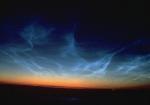 Noctilucent Clouds
19.06.2005
Sometimes it's night on the ground but day in the air. As the Earth rotates to eclipse the Sun, sunset rises up from the ground. Therefore, at sunset on the ground, sunlight still shines on clouds above.
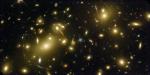 Abell 2218: A Galaxy Cluster Lens
1.02.2000
Gravity can bend light. Almost all of the bright objects in this recently released Hubble Space Telescope image are galaxies in the cluster known as Abell 2218. The cluster is so massive and so compact that its gravity bends and focuses the light from galaxies that lie behind it.
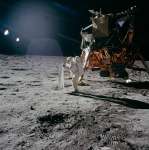 Apollo 11: Catching Some Sun
22.07.2017
Bright sunlight glints and long dark shadows mark this image of the lunar surface. It was taken July 20, 1969 by Apollo 11 astronaut Neil Armstrong, the first to walk on the Moon. Pictured...
|
January February March April May June July August September |
|||||||||||||||||||||||||||||||||||||||||||||||||