
|
You entered: surface
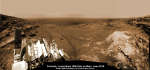 1000 Sols
13.06.2015
Shortly before Mars' June 2015 conjunction, the Curiosity Rover celebrated 1000 sols on the red planet. After its August 5, 2012 landing, Curiosity's 1000th sol or martian day on the surface corresponded to planet Earth's calendar date May 31, 2015.
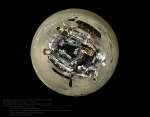 Yutu on a Little Planet
13.02.2016
Tracks lead to a small robot perched near the top of this bright little planet. Of course, the planet is really the Moon. The robot is the desk-sized Yutu rover, leaving its looming Chang'e 3 lander after a after a mid-December 2013 touch down in the northern Mare Imbrium.
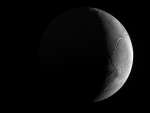 Crescent Enceladus
9.02.2017
Peering from the shadows, the Saturn-facing hemisphere of tantalizing inner moon Enceladus poses in this Cassini spacecraft image. North is up in the dramatic scene captured last November as Cassini's camera was pointed in a nearly sunward direction about 130,000 kilometers from the moon's bright crescent.
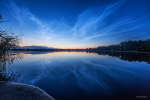 The Veins of Heaven
26.07.2019
Transfusing sunlight through a still dark sky, this exceptional display of noctilucent clouds was captured earlier this month, reflected in the calm waters of Vallentuna Lake near Stockholm, Sweden. From the edge of space...
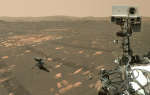 Perseverance Selfie with Ingenuity
1.07.2021
On sol 46 (April 6, 2021) the Perseverance rover held out a robotic arm to take its first selfie on Mars. The WATSON camera at the end of the arm was designed to take close-ups of martian rocks and surface details though, and not a quick snap shot of friends and smiling faces.
 APOD: 2024 January 22 Б Shadows of Mountain and Moon
22.01.2024
Can the Moon and a mountain really cast similar shadows? Yes, but the division between light and dark does not have to be aligned. Pictured, a quarter moon was captured above the mountain Grivola in Italy in early October of 2022.
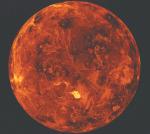 The North Pole of Venus
14.05.2003
If you could look down on the North Pole of Venus what would you see? The Magellan probe that orbited Venus from 1990 to 1994 was able to peer through the thick Venusian clouds and build up the above image by emitting and re-detecting cloud-penetrating radar.
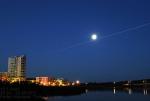 Moons and Bright Mars
1.08.2003
In this serene view, the moons of Earth along with the bright planet Mars shine above the city of Turku near the southwestern tip of Finland. Of course Earth's large natural satellite, the Moon, at a distance of 400,000 kilometers, is by far the brightest object in this sky.
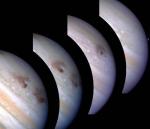 Jupiter Swallows Comet Shoemaker Levy 9
4.08.1998
What happens when a comet encounters a planet? If the planet has a rocky surface, a huge impact feature will form. A giant planet like Jupiter, however, is mostly gas. When Comet Shoemaker-Levy 9 struck Jupiter in 1994, each piece was swallowed into the vast Jovian atmosphere.
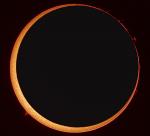 An Annular Solar Eclipse at High Resolution
5.10.2005
On Monday, part of the Sun went missing. The missing piece was no cause for concern -- the Moon was only momentarily in the way. The event was not a total eclipse of the Sun for any Earth-bound sky enthusiast but rather, at best, an annular eclipse, where the Moon blocked most of the Sun.
|
January February March April May June July August September October |
|||||||||||||||||||||||||||||||||||||||||||||||||