
|
You entered: Milky Way
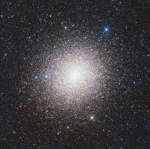 Globular Star Cluster 47 Tuc
10.03.2022
Globular star cluster 47 Tucanae is a jewel of the southern sky. Also known as NGC 104, it roams the halo of our Milky Way Galaxy along with some 200 other globular star clusters. The second brightest globular cluster (after Omega Centauri) as seen from planet Earth, 47 Tuc lies about 13,000 light-years away.
 Stellar Streams in the Local Universe
27.09.2024
The twenty galaxies arrayed in these panels are part of an ambitious astronomical survey of tidal stellar streams. Each panel presents a composite view; a deep, inverted image taken from publicly available imaging surveys of a field that surrounds a nearby massive galaxy image.
 Messier 87
20.02.2025
Enormous elliptical galaxy Messier 87 is about 50 million light-years away. Also known as NGC 4486, the giant galaxy holds trillions of stars compared to the mere billions of stars in our large spiral Milky Way. M87 reigns as the large central elliptical galaxy in the Virgo galaxy cluster.
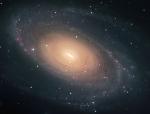 Bright Galaxy M81
20.06.2002
Big and beautiful spiral galaxy M81, in the northern constellation Ursa Major, is one of the brightest galaxies visible in the skies of planet Earth. This superbly detailed view reveals its bright nucleus, grand spiral arms and sweeping cosmic dust lanes with a scale comparable to the Milky Way.
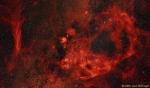 The Gum Nebula
19.05.2006
Named for Australian astronomer Colin Stanley Gum (1924-1960), The Gum Nebula is so large and close it is actually hard to see. In fact, we are only about 450 light-years from the front edge and 1,500 light-years from the back edge of this cosmic cloud of glowing hydrogen gas.
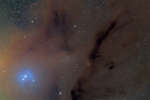 Streaming Dark Nebulas near B44
15.06.2009
Dark dust lit by the bright yellow star Antares highlight this photogenic starscape of the southern sky. A wider angle image shows the central band of our Milky Way Galaxy connected to Antares by streams of dust knows as the Dark River. At the head of the Dark River the dust appears in dense knots.
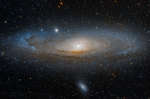 M31: The Andromeda Galaxy
30.07.2014
Andromeda is the nearest major galaxy to our own Milky Way Galaxy. Our Galaxy is thought to look much like Andromeda. Together these two galaxies dominate the Local Group of galaxies. The diffuse light from Andromeda is caused by the hundreds of billions of stars that compose it.
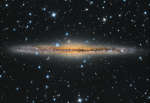 Edge On NGC 891
12.01.2017
Large spiral galaxy NGC 891 spans about 100 thousand light-years and is seen almost exactly edge-on from our perspective. In fact, about 30 million light-years distant in the constellation Andromeda, NGC 891 looks a lot like our Milky Way.
 NGC 6822: Barnard s Galaxy
2.12.2021
Grand spiral galaxies often seem to get all the glory, flaunting their young, bright, blue star clusters in beautiful, symmetric spiral arms. But small galaxies form stars too, like nearby NGC 6822, also known as Barnard's Galaxy.
 APOD: 2025 August 29 Б A Dark Veil in Ophiuchus
29.08.2025
The diffuse hydrogen-alpha glow of emission region Sh2-27 fills this cosmic scene. The field of view spans nearly 3 degrees across the nebula-rich constellation Ophiuchus toward the central Milky Way. A Dark Veil...
|
January February March April May June July August September October |
|||||||||||||||||||||||||||||||||||||||||||||||||