
|
You entered: outer Galaxy
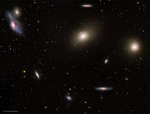 In the Heart of the Virgo Cluster
6.04.2015
The Virgo Cluster of Galaxies is the closest cluster of galaxies to our Milky Way Galaxy. The Virgo Cluster is so close that it spans more than 5 degrees on the sky - about 10 times the angle made by a full Moon.
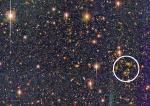 Weighing Empty Space
8.07.2002
Sometimes staring into empty space is useful. Pictured above is a region of sky that was picked because it had, well, nothing: no bright stars, no bright galaxies, and no picturesque nebulas. What could not be avoided, however, were a few stars in our own Galaxy, and many distant galaxies strewn across the universe.
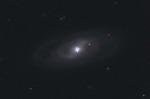 The Einstein Cross Gravitational Lens
26.03.2005
Most galaxies have a single nucleus -- does this galaxy have four? The strange answer leads astronomers to conclude that the nucleus of the surrounding galaxy is not even visible in this image. The central cloverleaf is rather light emitted from a background quasar.
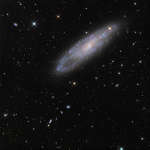 NGC 247 and Friends
15.01.2020
About 70,000 light-years across, NGC 247 is a spiral galaxy smaller than our Milky Way. Measured to be only 11 million light-years distant it is nearby though. Tilted nearly edge-on as seen from our perspective, it dominates this telescopic field of view toward the southern constellation Cetus.
 NGC 247 and Friends
4.09.2024
About 70,000 light-years across, NGC 247 is a spiral galaxy smaller than our Milky Way. Measured to be only 11 million light-years distant it is nearby though. Tilted nearly edge-on as seen from our perspective, it dominates this telescopic field of view toward the southern constellation Cetus.
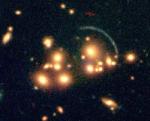 Ring Around the Cluster
3.01.1999
It is difficult to hide a galaxy behind a cluster of galaxies. The closer cluster's gravity will act like a huge lens, pulling images of the distant galaxy around the sides and greatly distorting them. This is just the case observed in the above recently released image from the VLT.
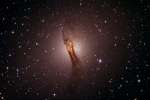 Centaurus A
12.03.2010
Only 11 million light-years away, Centaurus A is the closest active galaxy to planet Earth. Spanning over 60,000 light-years, the peculiar elliptical galaxy, also known as NGC 5128, is featured in this sharp color image.
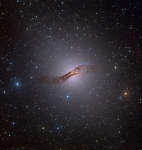 Centaurus A
16.03.2022
A mere 11 million light-years away, Centaurus A is the closest active galaxy to planet Earth. Spanning over 60,000 light-years, the peculiar elliptical galaxy also known as NGC 5128, is featured in this sharp telescopic view.
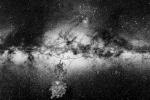 Sagittarius Dwarf to Collide with Milky Way
15.02.1998
Our Galaxy is being invaded. Recent observations indicate that in the next 100 million years, the Sagittarius Dwarf galaxy will move though the disk of our own Milky Way Galaxy yet again . The Sagittarius...
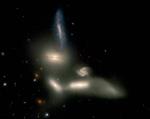 Seyfert's Sextet
23.01.2003
Known as Seyfert's Sextet, this intriguing group of galaxies lies in the head portion of the split constellation Serpens. The sextet actually contains only four interacting galaxies, though. Near the center of this...
|
January February March April May June July August September October |
|||||||||||||||||||||||||||||||||||||||||||||||||