
|
You entered: massive stars
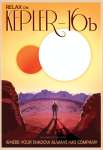 Where Your Shadow Has Company
20.02.2016
Want to take a relaxing interstellar vacation? Consider visiting Kepler-16b, a world in a binary star system. In fact Kepler-16b is the first discovered circumbinary planet. It was detected in a wide 229 day orbit around a close pair of cool, low-mass stars some 200 light-years away.
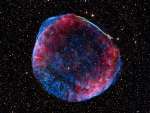 SN 1006 Supernova Remnant
1.08.2009
A new star, likely the brightest supernova in recorded human history, lit up planet Earth's sky in the year 1006 AD. The expanding debris cloud from the stellar explosion, found in the southerly constellation of Lupus, still puts on a cosmic light show across the electromagnetic spectrum.
 SN 1006 Supernova Remnant
4.07.2008
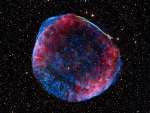
A new star, likely the brightest supernova in recorded human history, lit up planet Earth's sky in the year 1006 AD. The expanding debris cloud from the stellar explosion, found in the southerly constellation of Lupus, still puts on a cosmic light show across the electromagnetic spectrum.
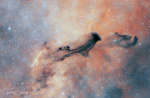 APOD: 2026 February 20 Б B93: A Dark Interstellar Ghost
20.02.2026
"A ghost in the Milky WayББ says Christian Bertincourt, the astrophotographer behind this striking image of Barnard 93 (B93). The 93rd entry in BarnardБs Catalogue of Dark Nebulae, B93 lies within the Small Sagittarius Star Cloud (Messier 24), where its darkness stands in stark contrast to bright stars and gas in the background.
 The Once and Future Stars of Andromeda
20.01.2011
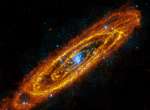
The big, beautiful Andromeda Galaxy, aka M31, is a spiral galaxy a mere 2.5 million light-years away. Two space-based observatories have combined to produce this intriguing composite image of Andromeda, at wavelengths outside the visible spectrum. The remarkable view follows the locations of this galaxy's once and future stars.
 X rays from Supernova Remnant SN 1006
23.04.2013
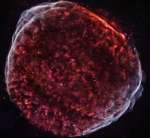
What looks like a puff-ball is surely the remains of the brightest supernova in recorded human history. In 1006 AD, it was recorded as lighting up the nighttime skies above areas now known as China, Egypt, Iraq, Italy, Japan, and Switzerland.
 M2 9: Wings of a Butterfly Nebula
27.12.1998
Are stars better appreciated for their art after they die? Actually, stars usually create their most artistic displays as they die. In the case of low-mass stars like our Sun and M2-9 pictured above, the stars transform themselves from normal stars to white dwarfs by casting off their outer gaseous envelopes.
 M2 9: Wings of a Butterfly Nebula
12.06.2005
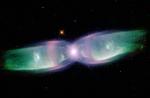
Are stars better appreciated for their art after they die? Actually, stars usually create their most artistic displays as they die. In the case of low-mass stars like our Sun and M2-9 pictured above, the stars transform themselves from normal stars to white dwarfs by casting off their outer gaseous envelopes.
 M2 9: Wings of a Butterfly Nebula
21.03.1999
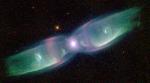
Are stars better appreciated for their art after they die? Actually, stars usually create their most artistic displays as they die. In the case of low-mass stars like our Sun and M2-9 pictured above, the stars transform themselves from normal stars to white dwarfs by casting off their outer gaseous envelopes.
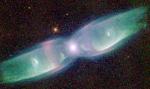 M2 9: Wings of a Butterfly Nebula
1.02.2004
Are stars better appreciated for their art after they die? Actually, stars usually create their most artistic displays as they die. In the case of low-mass stars like our Sun and M2-9 pictured above, the stars transform themselves from normal stars to white dwarfs by casting off their outer gaseous envelopes.
|
January February March April |
|||||||||||||||||||||||||||||||||||||||||||||||||