
|
You entered: unusual
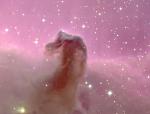 The Horsehead Nebula
13.07.2003
One of the most identifiable nebulae in the sky, the Horsehead Nebula in Orion, is part of a large, dark, molecular cloud. Also known as Barnard 33, the unusual shape was first discovered on a photographic plate in the late 1800s.
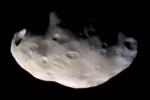 Pandora: A Shepherd Moon of Saturn
23.11.2005
What does Saturn's small moon Pandora look like? To help find out, the robot Cassini spacecraft now orbiting Saturn passed about 50,000 kilometers from the unusual moon in early September. The highest resolution image of Pandora ever taken was then captured and is shown above in representative colors.
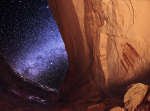 Milky Way Over Ancient Ghost Panel
19.05.2010
Long before Stonehenge was built, well before the Dead Sea Scrolls were written, ancient artists painted life-sized figures on canyon walls in Utah, USA -- but why? Nobody is sure. The entire panel of figures...
 Rosetta Approaches Comet Churyumov Gerasimenko
11.08.2014
What does it look like to approach a comet? Early this month humanity received a new rendition as the robotic Rosetta spacecraft went right up to -- and began orbiting -- the nucleus of Comet 67P/Churyumov-Gerasimenko.
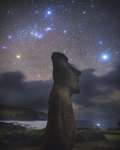 Orion above Easter Island
18.09.2017
Why were the statues on Easter Island built? No one is sure. What is sure is that over 800 large stone statues exist there. The Easter Island statues, stand, on the average, over twice as tall as a person and have over 200 times as much mass.
 Red Cloudbow over Delaware
13.06.2018
What kind of rainbow is this? In this case, no rain was involved -- what is pictured is actually a red cloudbow. The unusual sky arc was spotted last month during sunset in Rehoboth Beach, Delaware, USA.
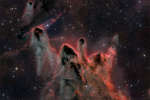 APOD: 2024 July 16 Б Cometary Globules
16.07.2024
What are these unusual interstellar structures? Bright-rimmed, flowing shapes gather near the center of this rich starfield toward the borders of the nautical southern constellations Pupis and Vela. Composed of interstellar gas and dust, the grouping of light-year sized cometary globules is about 1300 light-years distant.
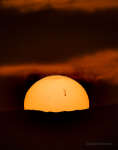 APOD: 2026 February 8 Б Active Sunspot Region 4366 Crosses the Sun
8.02.2026
An unusually active sunspot region is now crossing the Sun. The region, labelled AR 4366, is much larger than the Earth and has produced several powerful solar flares over the past ten days. In the featured image, the region is marked by large and dark sunspots toward the upper right of the Sun's disk.
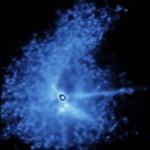 The T Tauri Star Forming System
4.06.2001
What did the Sun look like before there were planets? A prototype laboratory for the formation of low mass stars like our Sun is the T Tauri system, one of the brighter star systems toward the constellation of Taurus. In young systems, gravity causes a gas cloud to condense.
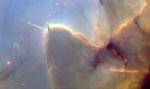 Trifid Pillars and Jets
30.12.2001
Dust pillars are like interstellar mountains. They survive because they are more dense than their surroundings, but they are being slowly eroded away by a hostile environment. Visible in the above picture...
|
January February March April May June July August |
||||||||||||||||||||||||||||||||||||||||||||||||||||||||