
|
You entered: distance
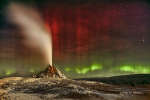 Aurora Over White Dome Geyser
2.10.2016
Sometimes both heaven and Earth erupt. Colorful aurorae erupted unexpectedly a few years ago, with green aurora appearing near the horizon and brilliant bands of red aurora blooming high overhead. A bright Moon lit the foreground of this picturesque scene, while familiar stars could be seen far in the distance.
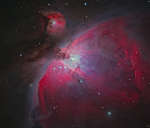 At the Heart of Orion
12.03.2017
Near the center of this sharp cosmic portrait, at the heart of the Orion Nebula, are four hot, massive stars known as the Trapezium. Tightly gathered within a region about 1.5 light-years in radius, they dominate the core of the dense Orion Nebula Star Cluster.
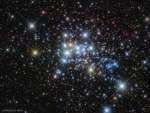 The Massive Stars in Westerlund 1
20.06.2017
Star cluster Westerlund 1 is home to some of the largest and most massive stars known. It is headlined by the star Westerlund 1-26, a red supergiant star so big that if placed in the center of our Solar System, it would extend out past the orbit of Jupiter.
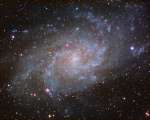 M33: Triangulum Galaxy
30.11.2017
The small, northern constellation Triangulum harbors this magnificent face-on spiral galaxy, M33. Its popular names include the Pinwheel Galaxy or just the Triangulum Galaxy. M33 is over 50,000 light-years in diameter, third largest in the Local Group of galaxies after the Andromeda Galaxy (M31), and our own Milky Way.
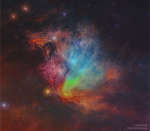 Seven Dusty Sisters
28.05.2018
Is this really the famous Pleaides star cluster? Known for its iconic blue stars, the Pleaides is shown here in infrared light where the surrounding dust outshines the stars. Here three infrared colors have been mapped into visual colors (R=24, G=12, B=4.6 microns).
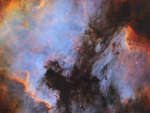 North America and the Pelican
16.09.2021
Fans of our fair planet might recognize the outlines of these cosmic clouds. On the left, bright emission outlined by dark, obscuring dust lanes seems to trace a continental shape, lending the popular name North America Nebula to the emission region cataloged as NGC 7000.
 APOD: 2024 August 4 Б Gaia: Here Comes the Sun
4.08.2024
What would it look like to return home from outside our galaxy? Although designed to answer greater questions, data from ESA's robotic Gaia mission is helping to provide a uniquely modern perspective on humanity's place in the universe.
 Peculiar Galaxies of Arp 273
9.01.2025
The colorful, spiky stars are in the foreground of this image taken with a small telescope on planet Earth. They lie well within our own Milky Way Galaxy. But the two eye-catching galaxies in the frame lie far beyond the Milky Way, at a distance of over 300 million light-years.
 Driving to the Sun
27.07.1996
How long would it take to drive to the Sun? Brittany, age 7, and D.J., age 12, ponder this question over dinner one evening. James, also age 7, suggests taking a really fast racing car while Christopher, age 4, eagerly agrees.
 A Quasar Portrait Gallery
25.11.1996
QUASARs (QUASi-stellAR objects) lie near the edge of the observable Universe. Discovered in 1963, astronomers were astounded - to be visible at such extreme distances of billions of light-years they must emit prodigious amounts of energy. Where does the energy come from?
|
January February March April May June July August September October |
|||||||||||||||||||||||||||||||||||||||||||||||||