
|
You entered: star
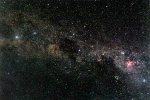 The Milky Way Near the Southern Cross
3.05.1996
This breathtaking patch of sky would be above you were you to stand at the south pole of the Earth. Just above and to the right of the photograph's center are the four stars that mark the boundaries of the famous Southern Cross.
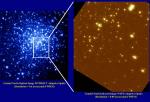 NGC 6934 from Gemini North
30.06.1999
What's going on near the center of globular cluster NGC 6934? The blur caused by the Earth's atmosphere has prevented astronomers from discerning individual stars in this unusual environment. Telescopes in space can help, but the new Gemini North telescope took the above picture from the ground.
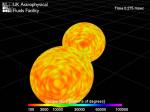 On the Origin of Gold
5.04.2001
Where did the gold in your jewelry originate? No one is completely sure. The relative average abundance in our Solar System appears higher than can be made in the early universe, in stars, and even in typical supernova explosions. Some astronomers now
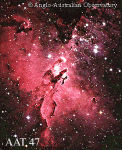 M16: Dust and an Open Cluster
1.11.1995
The photogenic M16 shown above is composed of a young star cluster and a spectacular emission nebulae lined with distinct regions of interstellar dust. Most of the stars in the cluster can be seen offset just above and to the right of the photograph's center.
 Meteor Milky Way
26.11.1998
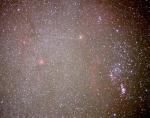
The bold, bright star patterns of Orion (right) are a familiar sight to even casual skygazers. But this gorgeous color photo also features a subtler spectacle - the faint stars of the Milky Way.
 Forest and Sky
17.11.2007
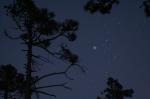
With pine trees in dim silhouette, this skyscape from Breil-sur-Roya in southern France was captured on November 11. In the early evening scene, a satellite seems to streak through the branches, while bright, round, fuzzy Comet Holmes appears to lie just beyond them, near the stars of the constellation Perseus.
 NGC 1850: Not Found in the Milky Way
12.07.2001
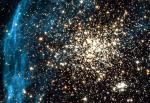
A mere 168,000 light-years distant, this large, lovely cluster of stars, NGC 1850, is located near the outskirts of the central bar structure in our neighboring galaxy, the Large Magellanic Cloud. A first...
 A Treasure Chest in the Carina Nebula
17.09.2026
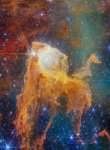
This treasure chest is full of stars. The featured image was obtained with NASA's James Webb Space Telescope and shows a dust pilar in the Carina Nebula inside our Galaxy, roughly 7500 light-years away.
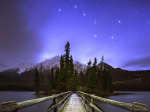 Big Dipper over Pyramid Mountain
21.11.2017
When did you first learn to identify this group of stars? Although they are familiar to many people around the world, different cultures have associated this asterism with different icons and folklore. Known...
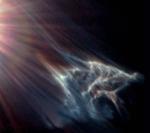 Reflecting Merope
4.12.2004
In the well known Pleiades star cluster, a star's light is slowly destroying this wandering cloud of gas and dust. Above, the star Merope lies just off the upper left edge of this picture from the Hubble Space Telescope.
|
January February March April May June July August September October |
|||||||||||||||||||||||||||||||||||||||||||||||||