
|
You entered: M 10
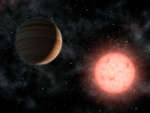 VB 10: A Large Planet Orbiting a Small Star
3.06.2009
Can a planet be as large as the star that it orbits? Recent observations have discovered that nearby Van Biesbroeck's star might have just such a large planet. Although VB 10 lies only...
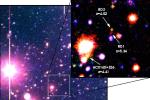 A Baby Galaxy
23.03.1998
What's the farthest galaxy known? The answer keeps changing as astronomers compete to find new galaxies which top the list. The new record holder is now the faint red smudge indicated in the above image by the arrow.
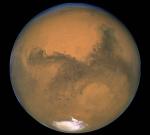 Big Mars from Hubble
27.08.2003
At about 10 am Universal Time today, Mars and Earth will pass closer than in nearly 60,000 years. Mars, noticeably red, will be the brightest object in the eastern sky just after sunset.
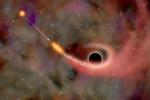 X Rays Indicate Star Ripped Up by Black Hole
23.02.2004
What could rip a star apart? A black hole. Giant black holes in just the right mass range would pull on the front of a closely passing star much more strongly than on the back.
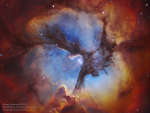 In the Center of the Trifid Nebula
31.10.2020
What's happening at the center of the Trifid Nebula? Three prominent dust lanes that give the Trifid its name all come together. Mountains of opaque dust appear near the bottom, while other dark filaments of dust are visible threaded throughout the nebula.
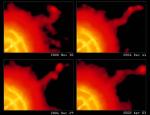 The Vela Pulsar s Dynamic Jet
3.07.2003
The Vela pulsar is a neutron star born over 10,000 years ago in a massive supernova explosion. Above, false-color x-ray images from the Chandra Observatory reveal details of this remnant pulsar's x-ray bright nebula along with emission from a spectacular jet of high-energy particles.
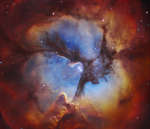 In the Center of the Trifid Nebula
28.01.2013
Clouds of glowing gas mingle with dust lanes in the Trifid Nebula, a star forming region toward the constellation of the Archer (Sagittarius). In the center, the three prominent dust lanes that give the Trifid its name all come together.
 In the Center of the Trifid Nebula
10.10.2015
Clouds of glowing gas mingle with dust lanes in the Trifid Nebula, a star forming region toward the constellation of the Archer (Sagittarius). In the center, the three prominent dust lanes that give the Trifid its name all come together.
 APOD: 2023 October 10 Б Hidden Orion from Webb
9.10.2023
The Great Nebula in Orion has hidden stars. To the unaided eye in visible light, it appears as a small fuzzy patch in the constellation of Orion. But this image was taken by the Webb Space Telescope in a representative-color composite of red and very near infrared light.
 APOD: 2025 July 11 Б The Veins of Heaven
10.07.2025
Transfusing sunlight as the sky grew darker, this exceptional display of noctilucent clouds was captured on July 10, reflected in the calm waters of Vallentuna Lake near Stockholm, Sweden. From the edge of space...
|
January February March April May June July August September |
|||||||||||||||||||||||||||||||||||||||||||||||||