
|
You entered: Rhea
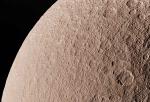 Rhea: Saturns Second Largest Moon
5.12.1999
Rhea is the second largest moon of Saturn, behind Titan, and the largest without an atmosphere. It is composed mostly of water ice, but has a small rocky core. Rhea's rotation and orbit are locked together (just like Earth's Moon) so that one side always faces Saturn.
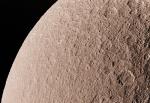 Rhea: Saturn's Second Largest Moon
8.06.2003
Rhea is the second largest moon of Saturn, behind Titan, and the largest without an atmosphere. It is composed mostly of water ice, but has a small rocky core. Rhea's rotation and orbit are locked together (just like Earth's Moon) so that one side always faces Saturn.
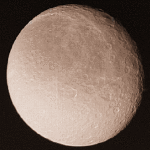 Rhea: Saturn's Second Largest Moon
14.10.1995
Rhea is the second largest moon of Saturn, behind Titan, and the largest without an atmosphere. It is composed mostly of water ice, but has a small rocky core. Rhea's rotation and orbit are locked together (just like Earth's Moon) so that one side always faces Saturn.
 A Great White Spot on Rhea
30.05.2005
Why caused this great white spot on the surface of Saturn's moon Rhea? The spot was first noticed last year by the robot Cassini spacecraft now orbiting Saturn. Cassini's flyby of Rhea in April imaged in the spot in great detail.
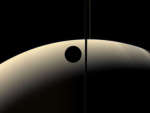 Crescent Rhea Occults Crescent Saturn
3.01.2015
Soft hues, partially lit orbs, a thin trace of the ring, and slight shadows highlight this understated view of the majestic surroundings of the giant planet Saturn. Looking nearly back toward the Sun, the robot Cassini spacecraft now orbiting Saturn captured crescent phases of Saturn and its moon Rhea in color a few years ago.
 Saturns Moon Rhea from Cassini
15.02.2005
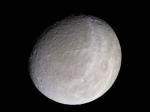
Each moon of Saturn seems to come with its own mystery. Rhea, Saturn's second largest moon behind Titan, shows unusual wisps, visible above as light colored streaks. Higher resolution images of the wisps show them to be made of long braided fractures.
 620 Kilometers Above Rhea
13.12.2005
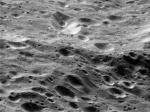
What does the surface of Saturn's moon Rhea look like? To help find out, the robot Cassini spacecraft currently orbiting Saturn was directed to fly right past the second largest moon of the gas giant planet late last month.
 Ringside with Rhea
29.03.2013
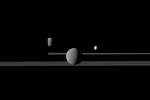
Orbiting in the plane of Saturn's rings, Saturnian moons have a perpetual ringside view of the gas giant planet. Of course, while passing near the ring plane the Cassini spacecraft also shares their stunning perspective. The thin rings themselves slice across the middle of this Cassini snapshot from April 2011.
 Crescent Rhea Occults Crescent Saturn
11.07.2006
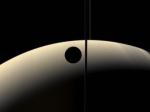
Soft hues, partially lit orbs, a thin trace of the ring, and slight shadows highlight this understated view of the majestic surroundings of the giant planet Saturn. Looking nearly back toward the Sun, the robot Cassini spacecraft now orbiting Saturn captured crescent phases of Saturn and its moon Rhea in color a few months ago.
 Dione and Rhea Ring Transit
22.11.2025
Seen to the left of Saturn's banded planetary disk, small icy moons Dione and Rhea are caught passing in front of the gas giant's extensive ring system in this sharp telescopic snapshot. The remarkable image was recorded on November 20, when Saturn's rings were nearly edge-on when viewed from planet Earth.
|
January February March April May June July August September |
|||||||||||||||||||||||||||||||||||||||||||||||||