
|
You entered: carbon dioxide
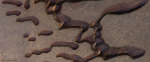 Striped Sand Dunes on Mars
6.01.2021
Why are these sand dunes on Mars striped? No one is sure. The featured image shows striped dunes in Kunowsky Crater on Mars, photographed recently with the Mars Reconnaissance OrbiterБs HiRISE Camera. Many Martian dunes are known to be covered unevenly with carbon dioxide (dry ice) frost, creating patterns of light and dark areas.
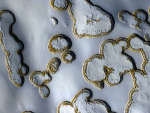 Dry Ice Pits on Mars
26.09.2011
Part of Mars is defrosting. Around the South Pole of Mars, toward the end of every Martian summer, the warm weather causes a section of the vast carbon-dioxide ice cap to evaporate. Pits begin to appear and expand where the carbon dioxide dry ice sublimates directly into gas.
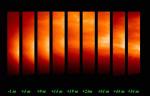 A Martian Sunset
1.08.1997
You've had a hard day rolling past Martian rocks, so now just relax your APXS and enjoy the Martian sunset. The above pictures taken by Mars Pathfinder highlight how clouds vary during the end of a Martian day.
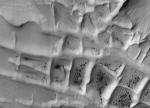 Mars: Ridges Near the South Pole
20.03.1998
No, it's not breakfast ... but looking down from an orbiting spacecraft, the odd intersecting ridges covering this area of Mars do present a waffle-like appearance. The cause of the ridge pattern is unknown but it suggests that more complex layered deposits lie below.
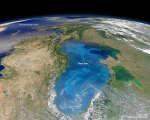 A White Battle in the Black Sea
24.04.2017
Trillions have died in the Earth's seas. Calcified shields of the dead already make up the white cliffs of Dover. The battle between ball-shaped light-colored single-celled plants -- phytoplankton called coccolithophores -- and even smaller, diamond-shaped viruses dubbed coccolithoviruses -- has raged for tens of millions of years.
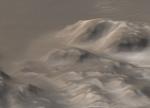 Frosty Mountains on Mars
30.07.2003
What causes the unusual white color on some Martian mountains? The answer can be guessed by noticing that the bright areas disappear as springtime takes hold in the south of Mars: dry ice. Unlike water ice, dry carbon dioxide ice sublimates directly to gas from its frozen state.
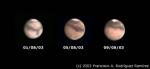 Mars Through a Small Telescope
19.08.2003
How does Mars appear through a small telescope? Viewed with the unaided eye or through a small telescope, possibly the most striking part of Mars' appearance is it's red color. The color derives from rust, iron oxide, which composes perhaps 10% of the Martian soil.
 Dry Ice Sled Streaks on Mars
17.06.2013
What creates these long and nearly straight grooves on Mars? Dubbed linear gullies, they appear on the sides of some sandy slopes during Martian spring, have nearly constant width, extend for as long as two kilometers, and have raised banks along their sides.
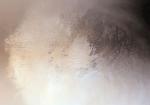 The South Pole of Mars
13.12.2001
The south pole of Mars is the bright area near the center of the detailed, subtly shaded color image above. Recorded in September of this year by the Mars Global Surveyor (MGS) spacecraft, the picture shows a region surrounding the 400 kilometer wide martian polar cap in the midst of southern hemisphere spring.
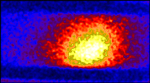 An Extreme UltraViolet View of the Comet
30.03.1996
As the Sun floods Comet Hyakutake with ultraviolet light gases in the coma scatter the radiation and fluoresce making the comet a bright source in the ultraviolet sky. The above image made using data...
|
January February March April May June July August September October |
|||||||||||||||||||||||||||||||||||||||||||||||||