
|
You entered: radio observation
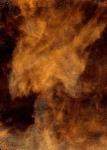 A Galactic Mushroom Cloud
3.02.1999
Part of our Galaxy is exploding. Recent radio observations show new details of hot gas expanding rapidly from an energetic star-forming region in our Galactic disk out into our Galaxy's halo. The combined power of at least hundreds of supernovae is needed to drive this tremendous expansion.
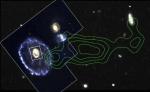 The Trail of the Intruder
24.02.1997
In yesterday's episode our hero, the Cartwheel galaxy, had survived a chance cosmic collision with a small intruder galaxy - triggering an expanding ring of star formation. Hot on the intruder's trail, a team of multiwavelength sleuths have compiled evidence tracking the reckless galaxy fleeing the scene.
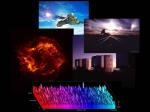 A Year of New Perspectives
28.12.1999
Fittingly, 1999 saw a decade of astronomical discoveries to an end with portents of things to come - embodied in new spacecraft, telescopes, and perspectives to explore the distant Universe across the electromagnetic spectrum. X-ray astronomy in particular will likely flourish in coming
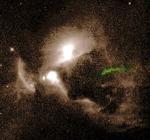 A Disk and Jet in Haro 6-5B
11.02.1999
Planets condense from disks. Several new Hubble Space Telescope pictures of stars surrounded by disks were released earlier this week. Since the glare of the central star usually makes a surrounding disk hard...
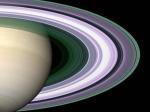 Particle Sizes in Saturns Rings
25.05.2005
What size particles compose Saturn's rings? To help find out, the robot Cassini spacecraft now orbiting Saturn broadcast radio waves of three different wavelengths right through the rings to Earth earlier this month.
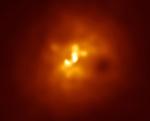 Abell 2597 s Cosmic Cavities
16.01.2002
Typical of large galaxy clusters billions of light-years away, Abell 2597 features hundreds of galaxies embedded in a cloud of multimillion degree gas which glows in x-rays. This Chandra Observatory x-ray image shows...
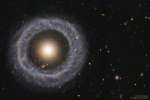 Hoags Object: A Nearly Perfect Ring Galaxy
27.11.2019
Is this one galaxy or two? This question came to light in 1950 when astronomer Arthur Hoag chanced upon this unusual extragalactic object. On the outside is a ring dominated by bright blue stars, while near the center lies a ball of much redder stars that are likely much older.
 APOD: 2024 February 18 Б Hoags Object: A Nearly Perfect Ring Galaxy
18.02.2024
Is this one galaxy or two? This question came to light in 1950 when astronomer Arthur Hoag chanced upon this unusual extragalactic object. On the outside is a ring dominated by bright blue stars, while near the center lies a ball of much redder stars that are likely much older.
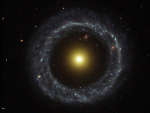 Hoags Object: A Strange Ring Galaxy
28.07.2013
Is this one galaxy or two? This question came to light in 1950 when astronomer Art Hoag chanced upon this unusual extragalactic object. On the outside is a ring dominated by bright blue stars, while near the center lies a ball of much redder stars that are likely much older.
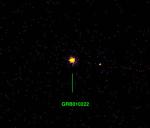 GRB010222: Gamma Ray Burst, X Ray Afterglow
13.04.2001
A fading afterglow from one of the most powerful explosions in the universe is centered in this false color image from the spacebased Chandra X-ray Observatory. The cosmic explosion, an enormously bright gamma-ray burst (GRB), originated in a galaxy billions of light-years away and was detected by the BeppoSAX satellite on February 22.
|
January February March April May June July August September |
|||||||||||||||||||||||||||||||||||||||||||||||||