
|
Keyword: aurora
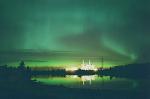 Aurora Over Edmonton
4.11.2003
Northern and southern locales saw many a beautiful aurora over the last week, as particles from several large solar flares impacted the Earth. Many reported unusually red auroras, although colors across the spectrum were also seen. Power grids and orbiting satellites braced for the onslaught, but little lasting damage was reported.
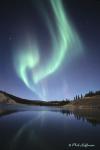 Dueling Auroras
7.08.2005
Will it be curtains for one of these auroras? A quick inspection indicates that it is curtains for both, as the designation "curtains" well categorizes the type of aurora pattern pictured. Another (informal) type is the corona.
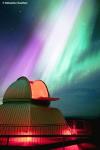 Mount Megantic Magnetic Storm
17.08.2000
Plasma from the Sun and debris from a comet both collided with planet Earth last Saturday morning triggering magnetic storms and a meteor shower in a dazzling atmospheric spectacle. The debris stream from comet...
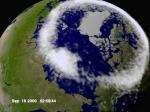 A Proton Aurora
17.12.2003
What are auroras made out of? Most auroras are caused by the solar wind exciting electrons that are funneled down the Earth's magnetic field. These electrons strike air molecules, liberating other electrons that glow when re-acquired.
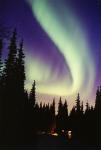 An Aurora Before the Storm
19.05.2000
Early April brought some of the most intense auroral storms this decade. An aurora on April 6 was reported to be the largest visible on Earth since 1989, and was seen throughout Europe and much of northern North America.
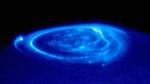 A Close Up of Aurora on Jupiter
19.12.2000
Jupiter has aurorae. Like Earth, the magnetic field of the gas giant funnels charged particles released from the Sun onto the poles. As these particles strike the atmosphere, electrons are temporarily knocked away from existing gas molecules. Electric force attracts these electrons back. As the electrons recombine to remake neutral molecules, auroral light is emitted.
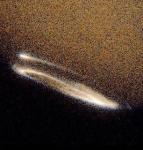 Jovian Aurora
23.01.1998
These two recently released Hubble Space Telescope close-ups show the Northern and Southern lights ... on Jupiter. Like aurora on Earth, these Jovian aurora are caused by charged particles funneled into the atmosphere above the planet's North (right) and South poles by magnetic fields.
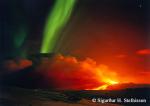 Volcano and Aurora in Iceland
13.06.2004
Sometimes both heaven and Earth erupt. In Iceland in 1991, the volcano Hekla erupted at the same time that auroras were visible overhead. Hekla, one of the most famous volcanoes in the world, has erupted at least 20 times over the past millennium, sometimes causing great destruction.
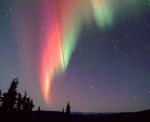 Comet and Aurora Over Alaska
22.04.2002
Can you spot the comet? Flowing across the frozen Alaskan landscape is an easily visible, colorful aurora. Just to the lower left, however, well in the background, is something harder to spot: Comet Ikeya-Zhang, the brightest comet of recent years. Although the aurora faded in minutes, the comet is just now beginning to fade.
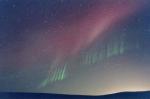 Rays from an Unexpected Aurora
5.08.2002
This aurora was a bit of a surprise. For starters, last Friday morning, no intense auroral activity was expected at all. Possibly more surprising, however, the aurora appeared to show an usual structure of green rays from some locations.
|
January February March April May June July August September October |
|||||||||||||||||||||||||||||||||||||||||||||||||