
|
Keyword: Saturn's Moon
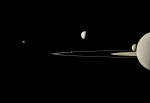 Moons of Saturn
16.10.2019
On July 29, 2011 the Cassini spacecraft's narrow-angle camera took this snapshot and captured 5 of Saturn's moons, from just above the ringplane. Left to right are small moons Janus and Pandora respectively 179 and 81 kilometers across, shiny 504 kilometer diameter Enceladus, and Mimas, 396 kilometers across, seen just next to Rhea.
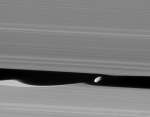 Daphnis the Wavemaker
20.01.2017
Plunging close to the outer edges of Saturn's rings, on January 16 the Cassini spacecraft captured this closest yet view of Daphnis. About 8 kilometers across and orbiting within the bright ring system's Keeler gap, the small moon is making waves.
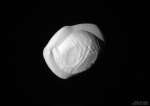 Saturns Moon Pan from Cassini
12.03.2017
Why does Saturn's moon Pan look so odd? Images taken last week from the robotic Cassini spacecraft orbiting Saturn have resolved the moon in unprecedented detail. The surprising images reveal a moon that looks something like a walnut with a slab through its middle.
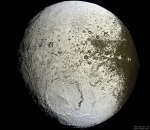 Saturns Iapetus: Painted Moon
2.06.2018
What has happened to Saturn's moon Iapetus? Vast sections of this strange world are dark as coal, while others are as bright as ice. The composition of the dark material is unknown, but infrared spectra indicate that it possibly contains some dark form of carbon.
 In, Through, and Beyond Saturn's Rings
3.04.2021
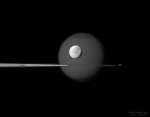
Four moons are visible on the featured image -- can you find them all? First -- and farthest in the background -- is Titan, the largest moon of Saturn and one of the larger moons in the Solar System. The dark feature across the top of this perpetually cloudy world is the north polar hood.
 Methone: Smooth Egg Moon of Saturn
6.11.2012
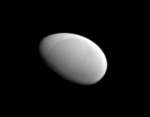
Why is this moon shaped like a smooth egg? The robotic Cassini spacecraft completed the first flyby ever of Saturn's small moon Methone in May and discovered that the moon has no obvious craters.
 Stereo Helene
31.05.2024
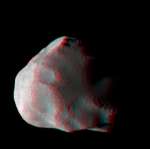
Get out your red/blue glasses and float next to Helene, small, icy moon of Saturn. Appropriately named, Helene is a Trojan moon, so called because it orbits at a Lagrange point. A Lagrange point is a gravitationally stable position near two massive bodies, in this case Saturn and larger moon Dione.
 Stereo Helene
28.03.2025
Get out your red/blue glasses and float next to Helene, small, icy moon of Saturn. Appropriately named, Helene is a Trojan moon, so called because it orbits at a Lagrange point. A Lagrange point is a gravitationally stable position near two massive bodies, in this case Saturn and larger moon Dione.
 Saturn and Six Moons
5.07.2021
How many moons does Saturn have? So far 82 have been confirmed, the smallest being only a fraction of a kilometer across. Six of its largest satellites can be seen here in a composite...
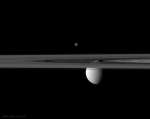 Moons Beyond Rings at Saturn
3.01.2022
What's happened to that moon of Saturn? Nothing -- Saturn's moon Rhea is just partly hidden behind Saturn's rings. In 2010, the robotic Cassini spacecraft then orbiting Saturn took this narrow-angle view looking across the Solar System's most famous rings.
|
January February March April May June July August September |
|||||||||||||||||||||||||||||||||||||||||||||||||