
|
Keyword: colliding galaxies
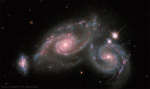 APOD: 2023 January 23 Б The Colliding Spiral Galaxies of Arp 274
23.01.2023
Two galaxies are squaring off in Virgo and here are the latest pictures. When two galaxies collide, the stars that compose them usually do not. This is because galaxies are mostly empty space and, however bright, stars only take up only a small fraction of that space.
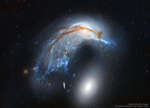 The Porpoise Galaxy from Hubble
6.02.2017
What's happening to this spiral galaxy? Just a few hundred million years ago, NGC 2936, the upper of the two large galaxies shown, was likely a normal spiral galaxy -- spinning, creating stars -- and minding its own business.
 APOD: 2023 September 25 Б Arp 142: The Hummingbird Galaxy
25.09.2023
What's happening to this spiral galaxy? Just a few hundred million years ago, NGC 2936, the upper of the two large galaxies shown at the bottom, was likely a normal spiral galaxy -- spinning, creating stars -- and minding its own business.
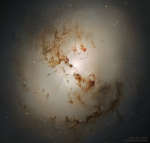 Central NGC 1316: After Galaxies Collide
26.01.2021
How did this strange-looking galaxy form? Astronomers turn detectives when trying to figure out the cause of unusual jumbles of stars, gas, and dust like NGC 1316. Inspection indicates that NGC 1316 is an enormous elliptical galaxy that somehow includes dark dust lanes usually found in a spiral galaxy.
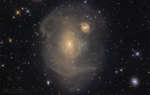 NGC 1316: After Galaxies Collide
17.05.2022
Astronomers turn detectives when trying to figure out the cause of startling sights like NGC 1316. Investigations indicate that NGC 1316 is an enormous elliptical galaxy that started, about 100 million years ago, to devour a smaller spiral galaxy neighbor, NGC 1317, just on the upper right.
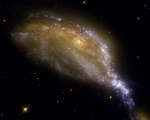 A Galaxy Collision in NGC 6745
30.09.2012
Galaxies don't normally look like this. NGC 6745 actually shows the results of two galaxies that have been colliding for only hundreds of millions of years. Just off the above digitally sharpened photograph to the lower right is the smaller galaxy, moving away.
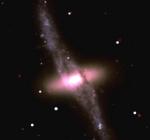 NGC 4650A: Strange Galaxy and Dark Matter
25.06.1998
This strangely distorted galaxy of stars is cataloged as NGC 4650A. It lies about 165 million light-years away in the southern constellation Centaurus. The complex system seems to have at least two parts, a flattened disk of stars with a dense, bright, central core and a sparse, sharply tilted ring of gas, dust and stars.
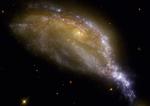 A Galaxy Collision in NGC 6745
2.11.2000
Galaxies don't normally look like this. NGC 6745 actually shows the results of two galaxies that have been colliding for only hundreds of millions of years. Just off the above photograph to the lower right is the smaller galaxy, moving away.
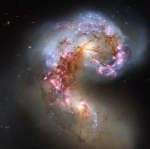 The Antennae Galaxies in Collision
3.12.2020
Sixty million light-years away toward the southerly constellation Corvus, these two large galaxies are colliding. The cosmic train wreck captured in stunning detail in this Hubble Space Telescope snapshot takes hundreds of millions of years to play out. Cataloged as NGC 4038 and NGC 4039, the galaxies' individual stars don't often collide though.
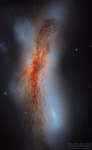 NGC 520: Colliding Galaxies from Hubble
7.09.2021
Is this one galaxy or two? The jumble of stars, gas, and dust that is NGC 520 is now thought to incorporate the remains of two separate disk galaxies. A defining component...
|
January February March April May June July August September October |
|||||||||||||||||||||||||||||||||||||||||||||||||