
|
Keyword: solstice
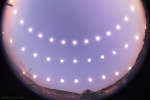 Equinox: The Sun from Solstice to Solstice
22.09.2008
Today is an equinox, a date when day and night are equal. Tomorrow, and every day until the next equinox, the night will be longer than the day in Earth's northern hemisphere, and the day will be longer than the night in Earth's southern hemisphere.
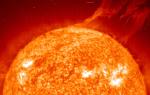 Eruptive Prominence
8.07.1999
Activity on our parent star continues to increase as the sun approaches a maximum in its 11-year solar cycle, expected in the year 2000. On June 14 - only a week before the solstice - the space-based SOHO observatory recorded this stunning view of an immense prominence erupting from the sun's southern latitudes (south is up).
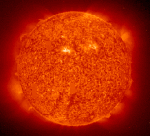 A Winter Solstice
21.12.1997
Today is the Winter Solstice, the shortest day of the year in the Northern Hemisphere. The yearly cycle of Seasons on planet Earth once again finds the Sun at its lowest point in the Northern Sky.
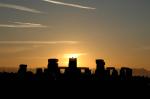 Sunrise Solstice at Stonehenge
21.06.2006
Today the Sun reaches its northernmost point in the planet Earth's sky. Called a solstice, the date traditionally marks a change of seasons -- from spring to summer in Earth's Northern Hemisphere and from fall to winter in Earth's Southern Hemisphere. Pictured above is the 2005 Summer Solstice celebration at Stonehenge in England.
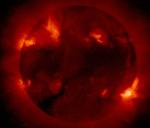 Solstice Sun In Soft X-rays
21.12.1998
The solstice occurs today at 8:56 PM Eastern Standard Time. At the solstice the sun reaches its most southerly position in the sky and winter begins for the Northern Hemisphere while summer starts South of the Equator.
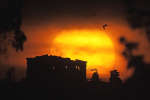 Sunrise over the Parthenon
21.06.2009
Today, the sun will stay in the sky longer than any other day of the year, as seen from the northern hemisphere of Earth. Named the Summer Solstice, today's maximum daylight is indicative of the high amount of sunlight this time of year that is primarily responsible for the heat of the summer season.
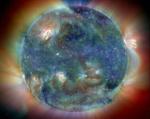 Solstice Celebration
21.12.2002
Aloha and Season's greetings! On December 22nd, at 01:14 Universal Time (December 21, 3:14pm Hawaii-Aleutian Standard Time), the Sun reaches its southernmost point in planet Earth's sky marking the final season change for the year 2002. In celebration, consider this delightfully detailed, brightly colored image of the active Sun.
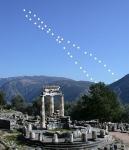 Sunrise Analemma
20.03.2003
Astronomically speaking, at the Equinox on March 21, 01:00 UT (March 20, 8:00 PM ET) the season changes. For this Equinox the Sun rises due east as it crosses the celestial equator heading north. In celebration, consider this spectacular sunrise analemma!
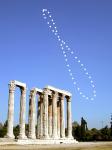 The Analemma and the Temple of Olympian Zeus
23.12.2006
An analemma is that figure-8 curve you get when you mark the position of the Sun at the same time each day throughout planet Earth's year. Above, 47 separate exposures (plus one foreground...
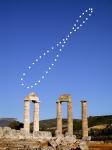 Analemma Over Ancient Nemea
21.06.2004
An anelemma is that figure-8 curve that you get when you mark the position of the Sun at the same time each day throughout planet Earth's year. Above, 44 separate exposures (plus...
|
January February March April May June July August September October |
|||||||||||||||||||||||||||||||||||||||||||||||||