
|
Keyword: Sirius
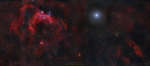 Seagull to Sirius
15.12.2016
This broad, beautiful mosaic spans almost 20 degrees across planet Earth's sky. The nebula-rich region lies near the edge of the Orion-Eridanus supperbubble, filled with looping, expanding shells of gas and dust embedded in molecular clouds near the plane of the Milky Way Galaxy.
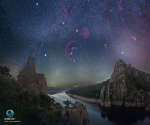 A Dark Winter Sky over MonfragЭe National Park in Spain
14.03.2017
You, too, can see a night sky like this. That is because MonfragЭe National Park in Spain, where this composite image was created, has recently had its night sky officially protected from potential future light pollution.
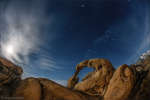 Mobius Arch Moonrise
28.02.2014
Only two days past full, February's moon shines through thin clouds, rising on the left in this fisheye night skyscape. The moonlight illuminates a weathered, rounded foreground in the Alabama Hills, conveniently located east of Mt. Whitney along the Sierra Nevada range in California, USA, planet Earth.
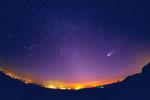 Sirius: The Brightest Star in the Night
11.06.2000
Sirius is the brightest star in the night sky. Sirius is visible on the far left of the above photograph, to the left of the constellation of Orion and Comet Hale-Bopp. Intrinsically, Sirius is over 20 times brighter than our Sun and over twice as massive.
 Frosted Leaf Orion
17.11.2010
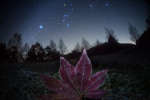
Sometimes, you can put some night sky in your art. Captured above Japan earlier this month, a picturesque night sky was photographed behind a picturesque frosted leaf. The reflecting ice crystals on the leaf coolly mimic the shining stars far in the background.
 Winter Hexagon Over Stagecoach Colorado
3.01.2011
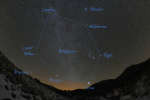
If you can find Orion, you might be able to find the Winter Hexagon. The Winter Hexagon involves some of the brightest stars visible, together forming a large and easily found pattern in the winter sky of Earth's northern hemisphere.
 Sirius, Sun, Moon, and Southern Cross
7.07.2000
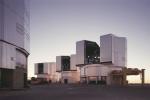
From left to right are the enclosures of Yepun (ye-poon; Sirius), Antu (an-too; Sun), Kueyen (qua-yen; Moon), and Melipal (me-li-pal; Southern Cross), pictured here as night falls at Paranal Observatory in northern Chile. These are the four 8.2 meter wide telescope units of the European Southern Observatory's Very Large Telescope (VLT).
 X-Rays From Sirius B
6.10.2000
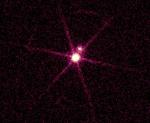
In visible light Sirius A (Alpha Canis Majoris) is the brightest star in the night sky, a closely watched celestial beacon throughout recorded history. Part of a binary star system only 8 light-years away, it was known in modern times to have a small companion star, Sirius B.
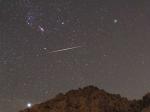 Comet, Meteor, Nebula, Star
22.12.2004
Several wonders of the late-year northern sky appeared together for a few fleeting moments on December 13. On the bottom left, just above the hill, is blue Sirius, the brightest star in the sky.
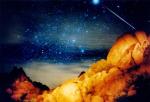 A Sirius Leonid Meteor
18.11.1999
In the sky or on the web, did you watch this year's Leonid meteor shower? If you did, meteors flashing through the night sky should be a familiar sight. Recorded last year during...
|
January February March April May June July August September October |
|||||||||||||||||||||||||||||||||||||||||||||||||