
|
You entered: Antares
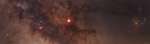 Eclipsed Moon in the Milky Way
17.06.2011
On June 15, the totally eclipsed Moon was very dark, with the Moon itself positioned on the sky toward the center of our Milky Way Galaxy. This simple panorama captures totality from northern Iran in 8 consecutive exposures each 40 seconds long.
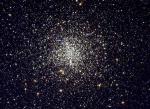 M4: The Closest Known Globular Cluster
23.05.2000
M4 is a globular cluster visible in dark skies about one degree west of the bright star Antares in the constellation Scorpius. M4 is perhaps the closest globular cluster at 7000 light years, meaning that we see M4 only as it was 7000 years ago, near the dawn of recorded human history.
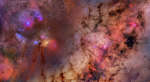 Scorpius Enhanced
16.06.2021
If Scorpius looked this good to the unaided eye, humans might remember it better. Scorpius more typically appears as a few bright stars in a well-known but rarely pointed out zodiacal constellation. To get a spectacular image like this, though, one needs a good camera, a dark sky, and some sophisticated image processing.
 APOD: 2025 May 27 Б Zeta and Rho Ophiuchi with Milky Way
27.05.2025
Behold one of the most photogenic regions of the night sky, captured impressively. Featured, the band of our Milky Way Galaxy runs diagonally along the bottom-left corner, while the colorful Rho Ophiuchi cloud complex is visible just right of center and the large red circular Zeta Ophiuchi Nebula appears near the top.
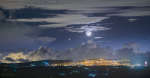 Earthshine Moon over Sicily
18.10.2021
Why can we see the entire face of this Moon? When the Moon is in a crescent phase, only part of it appears directly illuminated by the Sun. The answer is earthshine, also known as earthlight and the da Vinci glow.
 Milky Way with Airglow Australis
4.09.2015
After sunset on September 1, an exceptionally intense, reddish airglow flooded this Chilean winter night skyscape. Above a sea of clouds and flanking the celestial Milky Way, the airglow seems to ripple and flow across the northern horizon in atmospheric waves.
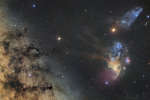 Saturn and Mars visit Milky Way Star Clouds
10.05.2016
Planets, stars, nebulas and a galaxy -- this impressive image has them all. Closest to home are the two planets Mars (right) and Saturn (center), visible as the two bright orange spots in the upper half of the featured image.
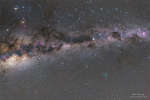 Close Comet and the Milky Way
25.03.2016
Comet 252P/Linear's lovely greenish coma is easy to spot in this expansive southern skyscape. Visible to the naked eye from the dark site near Flinders, Victoria, Australia, the comet appears tailless. Still, its surprisingly bright coma spans about 1 degree, posed here below the nebulae, stars, and dark rifts of the Milky Way.
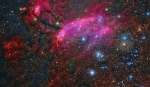 IC 4628: The Prawn Nebula
9.12.2016
South of Antares, in the tail of the nebula-rich constellation Scorpius, lies emission nebula IC 4628. Nearby hot, massive stars, millions of years young, irradiate the nebula with invisible ultraviolet light, stripping electrons from atoms. The electrons eventually recombine with the atoms to produce the visible nebular glow, dominated by the red emission of hydrogen.
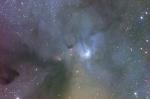 IC 4603: Reflection Nebula in Ophiuchius
21.07.2003
Why does this starfield photograph resemble an impressionistic painting? The effect is created not by digital trickery but by large amounts of interstellar dust. Dust, minute globs rich in carbon and similar in size to cigarette smoke, frequently starts in the outer atmospheres of large, cool, young stars.
|
January February March April May June July August September October |
|||||||||||||||||||||||||||||||||||||||||||||||||