
|
You entered: Antares
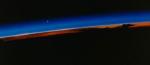 Venus On The Horizon
14.10.1997
The month of October features a sky full of planets, including Venus as the brilliant evening star. Besides the sun and moon, Venus is the brightest object visible in Earth's sky. This month, Venus appears in early evening near the red planet Mars and Mars' red giant rival Antares above the southwestern horizon.
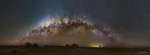 The Milky Way Sets
26.08.2016
Under dark skies the setting of the Milky Way can be a dramatic sight. Stretching nearly parallel to the horizon, this rich, edge-on vista of our galaxy above the dusty Namibian desert stretches from bright, southern Centaurus (left) to Cepheus in the north (right).
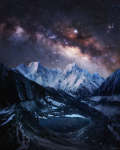 The Milky Way over Snow Capped Himalayas
26.05.2020
WhatБs higher than the Himalayas? Although the Himalayan Mountains are the tallest on planet Earth, they don't measure up to the Milky Way. Visible above the snow-capped mountains in the featured image is the arcing central band of our home galaxy.
 APOD: 2025 June 11 Б 25 Brightest Stars in the Night Sky
11.06.2025
Do you know the names of some of the brightest stars? It's likely that you do, even though some bright stars have names so old they date back to near the beginning of written language.
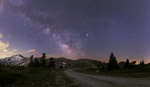 Milky Way and Planets Near Opposition
21.05.2016
In this early May night skyscape, a mountain road near Bursa, Turkey seems to lead toward bright planets Mars and Saturn and the center of our Milky Way Galaxy, a direction nearly opposite the Sun in planet Earth's sky.
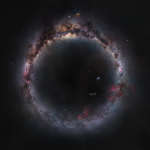 The Milky Ring
22.01.2021
An expanse of cosmic dust, stars and nebulae along the plane of our Milky Way galaxy form a beautiful ring in this projected all-sky view. The creative panorama covers the entire galaxy visible from planet Earth, an ambitious 360 degree mosaic that took two years to complete.
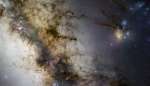 Gigagalaxy Zoom: Galactic Center
25.09.2009
From Sagittarius to Scorpius, the central Milky Way is a truly beautiful part of planet Earth's night sky. The gorgeous region is captured here, an expansive gigapixel mosaic of 52 fields spanning 34 by 20 degrees in 1200 individual images and 200 hours of exposure time.
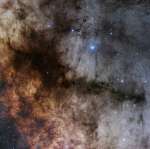 The Pipe Nebula
23.11.2012
East of Antares, dark markings sprawl through crowded star fields toward the center of our Milky Way Galaxy. Cataloged in the early 20th century by astronomer E. E. Barnard, the obscuring interstellar dust clouds include B59, B72, B77 and B78, seen in silhouette against the starry background.
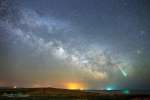 Meteor in the Milky Way
23.04.2015
Earth's April showers include the Lyrid Meteor Shower, observed for more than 2,000 years when the planet makes its annual passage through the dust stream of long-period Comet Thatcher. A grain...
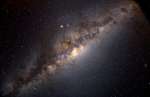 The Milky Way at 5000 Meters
4.01.2008
Climb up to 5000 meters (16,500 feet) above sea level, near Cerro Chajnantor in the northern Chilean Andes, and your night sky could encompass this cosmic vista. Recorded from that high and dry locale, the spectacular fish-eye image features the myriad stars and sprawling dust clouds of our Milky Way Galaxy.
|
January February March April May June July August September October |
|||||||||||||||||||||||||||||||||||||||||||||||||