
|
You entered: Europe
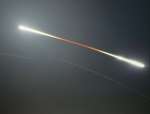 Moon Slide Slim
20.02.2008
No special filters - or even a telescope - are required to enjoy a leisurely lunar eclipse. In fact, watched from all over the night side of planet Earth, these regular celestial performances have entertained many casual skygazers. Still, this eye-catching picture of a lunar eclipse may look unfamiliar.
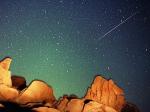 A Perseid Meteor
11.08.2004
The ongoing Perseid Meteor Shower should be at its strongest tonight and tomorrow night. Although meteors should be visible all night long, the best time to watch will be between 2:00 AM and dawn each night. In dark, moonless, predawn skies you may see dozens of meteors per hour.
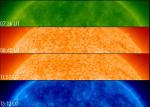 Mercury Spotting
8.05.2003
Can you spot the planet? The diminutive disk of Mercury, the solar system's innermost planet, spent about five hours crossing in front of the enormous solar disk yesterday (Wednesday, May 7th), as viewed from the general vicinity of planet Earth.
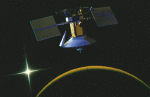 A World Explorer
25.08.1995
Ferdinand Magellan was a world explorer. Many consider him the greatest navigator of Europe's 16th century age of sea going exploration and credit his expedition with the first circumnavigation of planet Earth. NASA...
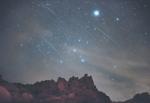 Leonids Over Joshua Tree National Park
5.11.2002
This year's Leonid Meteor Shower is predicted to have two peaks, like last year's. The first peak should come at about 04:00 hours Universal Time (UT) on November 19 and be primarily visible from Western Europe before sunrise.
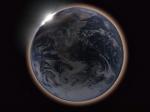 Solar Eclipse from the Moon
2.03.2007
Parts of Saturday's (March 3) lunar eclipse will be widely visible. For example, skywatchers in Europe, Africa, and western Asia will be able to see the entire spectacle of the Moon gliding through Earth's shadow, but in eastern North America the Moon will rise already in its total eclipse phase.
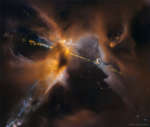 Duel Particle Beams in Herbig Haro 24
11.03.2018
This might look like a double-bladed lightsaber, but these two cosmic jets actually beam outward from a newborn star in a galaxy near you. Constructed from Hubble Space Telescope image data, the stunning scene...
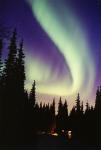 An Aurora Before the Storm
19.05.2000
Early April brought some of the most intense auroral storms this decade. An aurora on April 6 was reported to be the largest visible on Earth since 1989, and was seen throughout Europe and much of northern North America.
 Mercury Visualized from MESSENGER
11.12.2017
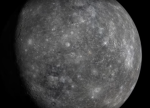
What would it be like to fly over the planet Mercury? Images and data taken from NASA's robotic MESSENGER spacecraft that orbited Mercury from 2011 to 2015 have been digitally combined to envision a virtual flight that highlights much of the hot planet's surface.
 Tempel Tuttle: The Leonid Comet
16.11.2002
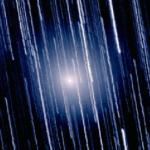
Star trails streak this composite time exposure of comet Tempel-Tuttle recorded by Tim Puckett on January 26, 1998. Then passing through the inner solar system on its 33 year orbit around the Sun, Tempel-Tuttle brightened unexpectedly, but binoculars or small telescopes were still required to visually observe it.
|
January February March April May June July August September |
|||||||||||||||||||||||||||||||||||||||||||||||||