
|
You entered: Europe
 APOD: 2023 June 29 Б A Message from the Gravitational Universe
28.06.2023
Monitoring 68 pulsars with very large radio telescopes, the North American Nanohertz Observatory for Gravitational Waves (NANOGrav) has uncovered evidence for the gravitational wave (GW) background by carefully measuring slight shifts in the arrival times of pulses. These shifts are correlated between different pulsars in a way that indicates that they are caused by GWs.
 Webb Telescope Mirror Rises after Assembly
8.05.2016
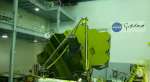
Move over Hubble -- here comes the James Webb Space Telescope (JWST). JWST promises to be the new most powerful telescope in space. In the last month, the 18-segment gold-plated primary mirror for JWST was unveiled. In the featured time-lapse video taken last week, the 6.5-meter diameter mirror was raised to a vertical position.
 A Picturesque Venus Transit
3.06.2012
The rare transit of Venus across the face of the Sun in 2004 was one of the better-photographed events in sky history. Both scientific and artistic images flooded in from the areas that could see the transit: Europe and much of Asia, Africa, and North America.
 Fifty Gravitational Wave Events Illustrated
3.11.2020
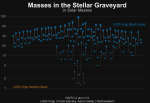
Over fifty gravitational wave events have now been detected. These events mark the distant, violent collisions of two black holes, a black hole and a neutron star, or two neutron stars. Most of the 50 events were detected in 2019 by the LIGO gravitational wave detectors in the USA and the VIRGO detector in Europe.
 APOD: 2025 September 11 Б The Umbra of Earth
10.09.2025
The dark, inner shadow of planet Earth is called the umbra. Shaped like a cone extending into space, it has a circular cross section most easily seen during a lunar eclipse.
 Hints of Higgs from the Large Hadron Collider
18.12.2011
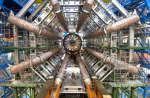
Why do objects have mass? To help find out, Europe's CERN has built the Large Hadron Collider (LHC), the most powerful particle accelerator yet created by humans. Since 2008, the LHC smashed protons into each other with unprecedented impact speeds.
 Leonids Above Torre de la Guaita
15.11.2014
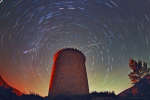
Leonids Meteor Shower came to an impressive crescendo in 1999. Observers in Europe saw a sharp peak in the number of meteors visible around 0210 UTC during the early morning hours of November 18. Meteor counts then exceeded 1000 per hour - the minimum needed to define a true meteor storm.
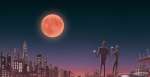 Tonight: A Supermoon Lunar Eclipse
26.09.2015
Tonight a bright full Moon will fade to red. Tonight's moon will be particularly bright because it is reaching its fully lit phase when it is relatively close to the Earth in its elliptical orbit.
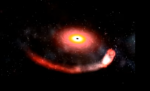 Unusual Signal Suggests Neutron Star Destroyed by Black Hole
2.09.2019
What created this unusual explosion? Three weeks ago, gravitational wave detectors in the USA and Europe -- the LIGO and Virgo detectors -- detected a burst of gravitational radiation that had the oscillating pattern expected when a black hole destroys a neutron star.
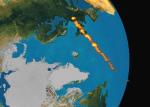 A Cosmic Snowball
30.05.1997
Like cosmic snowballs, fluffy comet-like objects the size of houses and composed mostly of water-ice, may be pummeling planet Earth 5 to 30 times a minute. This controversial theory was originally proposed in 1986 by Dr. Louis Frank (U. Iowa) based on data from NASA's Dynamics Explorer 1.
|
January February March April May June July August September |
|||||||||||||||||||||||||||||||||||||||||||||||||