
|
You entered: Io
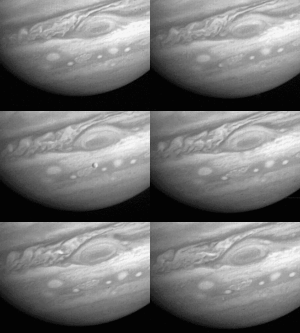 Approaching Jupiter
26.09.2000
In 1979 the Voyager 1 spacecraft compiled this view as it approached the gas giant Jupiter. Snapping a picture every time the Great Red Spot was properly aligned, the above time-lapse sequence shows not only spot rotation but also the swirling of neighboring clouds.
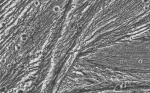 Galileo Photographs Ganymede
10.07.1996
Ganymede's surface is slowly being pulled apart. This photo of Ganymede was released earlier today by the Galileo team at NASA. The Galileo Spacecraft arrived at Jupiter in December 1995. In late June...
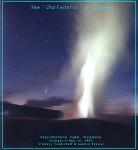 Old Faithful Meets Hale-Bopp
26.05.1997
As Comet Hale-Bopp leaves our Northern Skies, it provides us with yet another burst of joy. On May 11th the fading comet was photographed behind the famous "Old Faithful" water geyser of Yellowstone National Park, Wyoming, USA, Planet Earth.
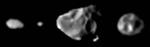 Jupiter's Inner Moons
27.11.1997
The potato-shaped inner moons of Jupiter are lined-up in this mosaic "family portrait" of these tiny Jovian satellites. The individual images were recorded over the last year by NASA's Galileo spacecraft and are scaled to the moons' relative sizes.
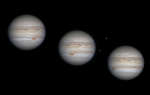 Jupiter s Swimming Storm
10.09.2020
A bright storm head with a long turbulent wake swims across Jupiter in these sharp telescopic images of the Solar System's ruling gas giant. Captured on August 26, 28, and September 1 (left to right) the storm approximately doubles in length during that period.
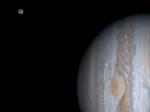 Jupiter, Europa, and Callisto
2.01.2001
As the robot Cassini spacecraft rounds Jupiter on its way toward Saturn, it has taken a sequence of images of the gas giant with its four largest moons. Previously released images have highlighted Ganymede and Io. Pictured above are the two remaining Galilean satellites: Europa and Callisto.
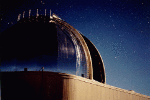 IRTF: Scanning the Infrared Skies
4.09.1996
Above, NASA's Infrared Telescope Facility (IRTF) poses in front of a starry background. Located on top of Hawaii's towering volcano Mauna Kea, the IRTF is the premier telescope for observing in near infrared light. This 3-meter telescope was established in 1979 and spends about half its time observing Solar System objects.
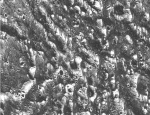 Ancient Cratered Plains on Ganymede
12.07.1996
The largest moon in the Solar System shows regions that are ancient and battered. The high density of craters demonstrate that patches of Ganymede are indeed billions of years old. This photo is one of a series released by NASA two days ago from the Galileo spacecraft orbiting Jupiter.
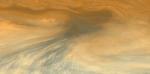 Jupiter's Dry Spots
12.06.1997
Known for its spectacular images of Jupiter's moons, Io, Ganymede, Callisto, and Europa, the robot spacecraft Galileo has also aggressively explored the Jovian atmosphere. In December of 1995, Galileo's atmospheric probe descended into Jupiter's clouds and reported a surprising absence of water.
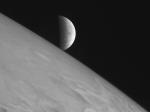 Europa Rising
7.05.2007
When passing Jupiter on your way to Pluto, what should you look for? NASA pondered just this question recently, and the response from one space enthusiast was to capture the above breathtaking moonrise.
|
January February March April May June July August September October |
|||||||||||||||||||||||||||||||||||||||||||||||||