
|
You entered: flare
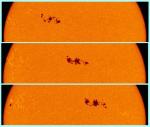 Sunspot Region 30
18.07.2002
The solar active region designated number 0030 is now appearing on the visible hemisphere of the closest star. Dwarfed by the Sun's disk, the group of sunspots which make up region 30 actually cover an enormous area -- nearly 10 times the size of Earth.
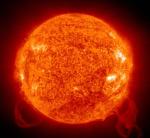 Double Eruptive Prominences
18.04.2003
Lofted over the Sun on looping magnetic fields, large solar prominences are composed of relatively cool, dense plasma. When seen against the brilliant solar disk they appear as dark filaments, but these enormous magnetic...
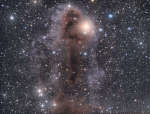 Lynds Dark Nebula 1251
31.05.2019
Stars are forming in Lynds Dark Nebula (LDN) 1251. About 1,000 light-years away and drifting above the plane of our Milky Way galaxy, the dusty molecular cloud is part of a complex of dark nebulae mapped toward the Cepheus flare region.
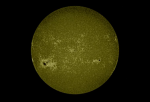 Sunspot Group AR 2192 Crackles
22.10.2014
One of the largest sunspot groups in recent years is now crossing the Sun. Labelled Active Region 2192, it has already thrown a powerful solar flare and has the potential to produce more.
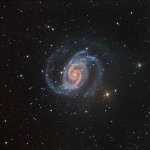 NGC 1566: The Spanish Dancer Spiral Galaxy
14.01.2022
An island universe of billions of stars, NGC 1566 lies about 60 million light-years away in the southern constellation Dorado. Popularly known as the Spanish Dancer galaxy, it's seen face-on from our Milky Way perspective.
 Lynds Dark Nebula 1251
22.06.2024
Stars are forming in Lynds Dark Nebula (LDN) 1251. About 1,000 light-years away and drifting above the plane of our Milky Way galaxy, LDN 1251 is also less appetizingly known as "The Rotten Fish Nebula." The dusty molecular cloud is part of a complex of dark nebulae mapped toward the Cepheus flare region.
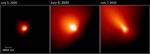 Comet LINEAR Breaks Up
31.07.2000
Unexpectedly, Comet LINEAR is breaking up. In retrospect, clues of its demise have been surfacing all month as the new comet has been approaching the Sun and brightening with dramatic flares. Above, the Hubble Space Telescope captured Comet C/1999 S4 LINEAR early this month blowing off a large piece of its crust.
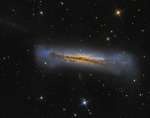 Edge on NGC 3628
4.11.2011
Sharp telescopic views of magnificent edge-on spiral galaxy NGC 3628 show a puffy galactic disk divided by dark dust lanes. The tantalizing scene puts many astronomers in mind of its popular moniker, The Hamburger Galaxy.
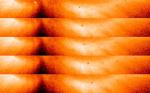 X ray Transit of Mercury
6.11.1999
This sequence of false color X-ray images captures a rare event - the passage or transit of planet Mercury in front of the Sun. Mercury's small disk is silhouetted against the bright background of X-rays from the hot Solar Corona.
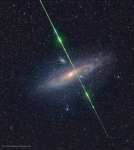 Meteor before Galaxy
12.08.2018
What's that green streak in front of the Andromeda galaxy? A meteor. While photographing the Andromeda galaxy in 2016, near the peak of the Perseid Meteor Shower, a sand-sized rock from deep space crossed right in front of our Milky Way Galaxy's far-distant companion.
|
January February March April May June July August September October |
|||||||||||||||||||||||||||||||||||||||||||||||||