
|
You entered: flare
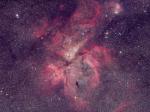 NGC 3372: The Great Nebula in Carina
17.05.2004
In one of the brightest parts of the Milky Way lies a nebula where some of the oddest things occur. NGC 3372, known as the Great Nebula in Carina, is home to massive stars and changing nebula.
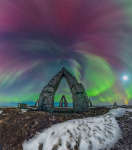 APOD: 2023 March 27 Б Aurora Over Arctic Henge
27.03.2023
Reports of powerful solar flares started a seven-hour quest north to capture modern monuments against an aurora-filled sky. The peaks of iconic Arctic Henge in Raufarhцfn in northern Iceland were already aligned with the stars: some are lined up toward the exact north from one side and toward exact south from the other.
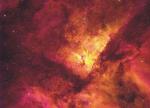 NGC 3372: The Great Nebula in Carina
19.07.1999
In one of the brightest parts of the Milky Way lies a nebula where some of the oddest things occur. NGC 3372, known as the Great Nebula in Carina, is home to massive stars and changing nebula.
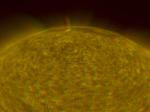 The Sun in Three Dimensions
24.04.2007
What does the Sun look like in all three spatial dimensions? To find out, NASA launched two STEREO satellites to perceive three dimensions on the Sun much like two eyes allow humans to perceive three dimensions on the Earth.
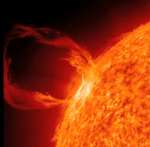 Large Eruptive Prominence Imaged by SDO
10.05.2010
Sometimes part of the Sun can just explode into space. These explosions might occur as powerful solar flares, coronal mass ejections, or comparatively tame eruptive solar prominences. Pictured above is one of the largest solar prominence eruptions yet observed, one associated with a subsequent coronal mass ejection.
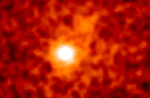 Gamma-Ray Quasars
23.10.1995
Gamma rays are more than 10,000 times more energetic than visible light. If you could "see" gamma rays, the night sky would seem very different indeed. The bright object in the center of the false color gamma-ray image above is quasar 3C279, a nondescript, faint, starlike object in the visible sky.
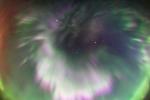 Northern Lights, September Skies
16.09.2005
So far, the Aurora Borealis or Northern Lights have made some remarkable visits to September's skies. The reason, of course, is the not-so-quiet Sun. In particular, a large solar active region now crossing...
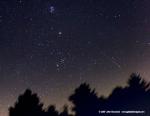 Moonless Perseid Sky
16.08.2007
Last weekend, dark, moonless night skies brought many sightings of Perseid meteors to skygazers all over planet Earth. Early Sunday morning astronomer John Chumack's camera captured this Perseid meteor streak with a flare near the end of its track over Yellow Springs, Ohio.
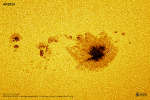 AR2835: Islands in the Photosphere
2.07.2021
Awash in a sea of incandescent plasma and anchored in strong magnetic fields, sunspots are planet-sized dark islands in the solar photosphere, the bright surface of the Sun. Found in solar active regions, sunspots...
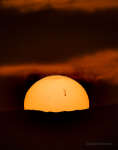 APOD: 2026 February 8 Б Active Sunspot Region 4366 Crosses the Sun
8.02.2026
An unusually active sunspot region is now crossing the Sun. The region, labelled AR 4366, is much larger than the Earth and has produced several powerful solar flares over the past ten days. In the featured image, the region is marked by large and dark sunspots toward the upper right of the Sun's disk.
|
January February March April May June July August September October |
|||||||||||||||||||||||||||||||||||||||||||||||||