
|
You entered: hydrogen
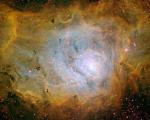 The Lagoon Nebula in Three Colors
6.10.2002
The bright Lagoon Nebula is home to a diverse array of astronomical objects. Particularly interesting sources include a bright open cluster of stars and several energetic star-forming regions. When viewed by eye, cluster light...
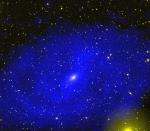 Ghost Galaxy NGC 2915
15.07.1998
How do you find a nearly invisible galaxy? Pictured above is the blue compact dwarf (BCD) galaxy NGC 2915. In visible light, shown above in yellow, this galaxy appears to be a normal dwarf galaxy, as indicated by the yellow smudge in the image center.
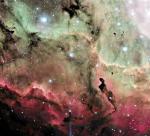 Close Up of the Lagoon Nebula
16.08.2004
Stars are battling gas and dust in the Lagoon Nebula but the photographers are winning. Also known as M8, this photogenic nebula is visible even without binoculars towards the constellation of Sagittarius. The energetic processes of star formation create not only the colors but the chaos.
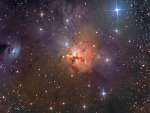 NGC 1579: Trifid of the North
30.01.2009
Colorful NGC 1579 resembles the better known Trifid Nebula, but lies much farther north in planet Earth's sky, in the heroic constellation Perseus. About 2,100 light-years away and 3 light-years across...
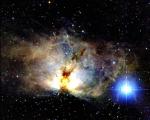 The Flame Nebula in Infrared
13.07.1999
What lights up the Flame Nebula? Fifteen hundred light years away towards the constellation of Orion lies a nebula which, from its glow and dark dust lanes, appears like a billowing fire. But fire, the rapid acquisition of oxygen, is not what makes this Flame glow.
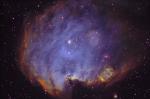 NGC 2174: Emission Nebula in Orion
8.12.2006
A lesser known sight in the nebula-rich constellation Orion, NGC 2174 can be found with binoculars near the head of the celestial hunter. About 6,400 light-years distant, the glowing cosmic cloud surrounds loose clusters of young stars.
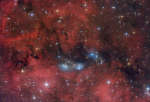 The NGC 6914 Complex
7.07.2022
A study in contrasts, this colorful skyscape features stars, dust, and glowing gas in the vicinity of NGC 6914. The interstellar complex of nebulae lies some 6,000 light-years away, toward the high-flying northern constellation Cygnus and the plane of our Milky Way Galaxy.
 Young Star Cluster NGC 346
2.05.2025
The most massive young star cluster in the Small Magellanic Cloud is NGC 346, embedded in our small satellite galaxy's largest star forming region some 210,000 light-years distant. Of course the massive stars of NGC 346 are short lived, but very energetic.
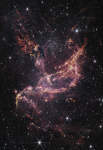 Young Star Cluster NGC 346
13.01.2023
The most massive young star cluster in the Small Magellanic Cloud is NGC 346, embedded in our small satellite galaxy's largest star forming region some 210,000 light-years distant. Of course the massive stars of NGC 346 are short lived, but very energetic.
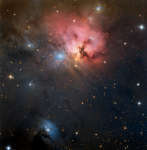 NGC 1579: Trifid of the North
9.03.2012
Colorful NGC 1579 resembles the better known Trifid Nebula, but lies much farther north in planet Earth's sky, in the heroic constellation Perseus. About 2,100 light-years away and 3 light-years across...
|
January February March April May June July August September October |
|||||||||||||||||||||||||||||||||||||||||||||||||