
|
You entered: hydrogen
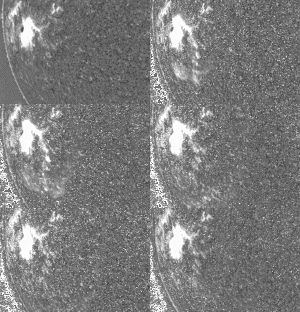 A Large Tsunami Shock Wave on the Sun
13.12.2006
Tsunami's this large don't happen on Earth. One week ago, a large solar flare from an Earth-sized sunspot produced a tsunami-type shock wave that was spectacular even for the Sun. Pictured above...
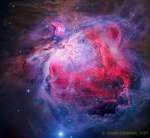 M42: Inside the Orion Nebula
30.10.2019
The Great Nebula in Orion, an immense, nearby starbirth region, is probably the most famous of all astronomical nebulas. Here, glowing gas surrounds hot young stars at the edge of an immense interstellar molecular cloud only 1500 light-years away.
 APOD: 2024 November 4 Б M42: The Great Nebula in Orion
4.11.2024
The Great Nebula in Orion, an immense, nearby starbirth region, is probably the most famous of all astronomical nebulas. Here, glowing gas surrounds hot young stars at the edge of an immense interstellar molecular cloud only 1500 light-years away.
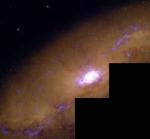 NGC 1808: A Nearby Starburst Galaxy
1.07.1998
NGC 1808 is a galaxy in turmoil. A barred spiral with marked similarities to our home Milky Way Galaxy, NGC 1808 is distinguished by a peculiar nucleus, an unusually warped disk, and strange flows of hydrogen gas out from the central regions.
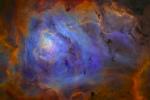 Blue Lagoon
25.08.2006
Stars come and go as you slide your cursor over this engaging image of M8, aka the Lagoon Nebula. Of course, the nebula is itself a star-forming region, but the stars that appear and disappear here include background and foreground stars that by chance lie along the same line of sight.
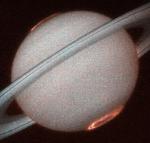 Saturnian Aurora
23.01.1999
Girdling the second largest planet in the Solar System, Saturn's Rings are one of the most spectacular sights for earthbound telescopes. This image from the orbiting Hubble Space Telescope's STIS instrument, offers a striking view of another kind of ring around Saturn - pole encircling rings of ultraviolet aurora.
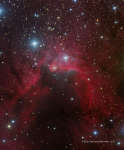 SH2-155: The Cave Nebula
23.03.2017
This skyscape features dusty Sharpless catalog emission region Sh2-155, the Cave Nebula. In the telescopic image, data taken through a narrowband filter tracks the reddish glow of ionized hydrogen atoms. About 2,400 light-years away, the scene lies along the plane of our Milky Way Galaxy toward the royal northern constellation of Cepheus.
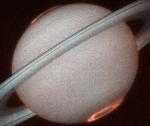 Saturnian Aurora
23.12.2001
the second largest planet in the Solar System, Saturn's Rings are one of the most spectacular sights for earthbound telescopes. This image from the orbiting Hubble Space Telescope's STIS instrument, offers a striking view of another kind of ring around Saturn - pole encircling rings of ultraviolet aurora.
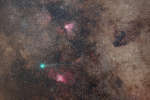 SWAN, Swan, Eagle
23.10.2025
Comet C/2025 R2 (SWAN) sports a greenish coma and fainter tail, seen against congeries of stars and dusty interstellar clouds in this 7 degree wide telescopic field of view from October 17. On that...
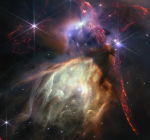 Webb's Rho Ophiuchi
25.10.2025
A mere 390 light-years away, Sun-like stars and future planetary systems are forming in the Rho Ophiuchi molecular cloud complex, the closest star-forming region to our fair planet. The James Webb Space Telescope's NIRCam peered into the nearby natal chaos to capture this infrared image at an inspiring scale.
|
January February March April May June July August September October |
|||||||||||||||||||||||||||||||||||||||||||||||||