
|
You entered: hydrogen
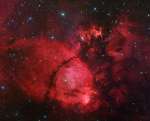 The Color of IC 1795
13.10.2011
This sharp cosmic portrait features glowing gas and obscuring dust clouds in IC 1795, a star forming region in the northern constellation Cassiopeia. Also cataloged as NGC 896, the nebula's remarkable details, shown...
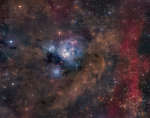 Young Suns of NGC 7129
16.10.2025
Young suns still lie within dusty NGC 7129, some 3,000 light-years away toward the royal constellation Cepheus. While these stars are at a relatively tender age, only a few million years old, it is likely that our own Sun formed in a similar stellar nursery around five billion years ago.
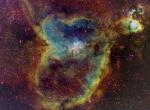 IC 1805: Light from the Heart
17.09.2004
Sprawling across hundreds of light-years, emission nebula IC 1805 is a mix of glowing interstellar gas and dark dust clouds. Only about 7,500 light-years away, stars were born in this region whose nickname - the Heart Nebula - derives from its suggestive shape (seen here sideways).
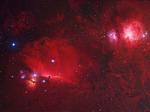 An Orion Deep Field
15.10.2006
Adrift 1,500 light-years away in one of the night sky's most recognizable constellations, the glowing Orion Nebula and the dark Horsehead Nebula are contrasting cosmic vistas. They both appear in this stunning composite digital image assembled from over 20 hours of data that includes exposures filtered to record emission from hydrogen atoms.
 MAVEN at Mars
26.09.2014
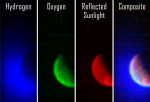
Launched on November 18, 2013, the MAVEN (Mars Atmosphere and Volatile EvolutioN) spacecraft completed its interplanetary voyage September 21, captured into a wide, elliptical orbit around Mars. MAVEN's imaging ultraviolet spectrograph has already...
 The Nebula And The Neutron Star
25.10.2000
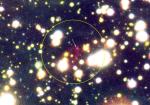
The lonely RX J1856.5-3754 was formed from the collapsed core of an exploding star. At a distance of 180 light-years it is the closest known neutron star. More massive than...
 Simulation: Formation of the First Stars
30.06.2021
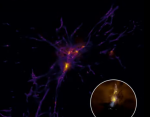
How did the first stars form? To help find out, the SPHINX computer simulation of star formation in the very early universe was created, some results of which are shown in the featured video. Time since the Big Bang is shown in millions of years on the upper left.
 Cosmic Clouds in the Unicorn
8.02.2020
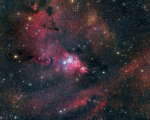
Interstellar clouds of hydrogen gas and dust abound in this gorgeous skyscape. The 3 degree wide field of view stretches through the faint but fanciful constellation Monoceros, the Unicorn. A star forming region cataloged as NGC 2264 is centered, a complex jumble of cosmic gas, dust and stars about 2,700 light-years distant.
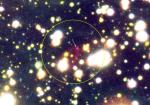 The Nebula And The Neutron Star
1.02.2003
The lonely RX J1856.5-3754 was formed from the collapsed core of an exploding star. At a distance of 180 light-years it is the closest known neutron star. More massive than...
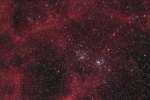 Double Cluster in Perseus
23.01.2014
This lovely starfield spans some seven full moons (about 3.5 degrees) across the heroic northern constellation of Perseus. Just right of center it holds the famous pair of open or galactic star clusters, h and Chi Perseii.
|
January February March April May June July August September October |
|||||||||||||||||||||||||||||||||||||||||||||||||